


On the recent wave of critiques of China’s export boom, a striking alignment has emerged across elite Western financial commentary. Among the sources feeding this convergence is a Goldman Sachs research note (in a proprietary client-only report) whose blunt “Beggar Thy Neighbor” framing has quickly circulated through the media ecosystem.
Three flagship financial outlets have seized the sentiment with remarkable enthusiasm and unanimity. The Financial Times declared that “China is making trade impossible,” Bloomberg warned that Beijing is “pulling the ladder up” on the Global South, and the Wall Street Journal pronounced that “China’s Growth Is Coming at the Rest of the World’s Expense.”
Taken together, these reports have formed a broader narrative: China’s swelling trade surplus, which was projected by Goldman to reach 1 percent of global GDP by the end of the decade, is not merely a garden-variety trade imbalance but a deliberate, zero-sum attack to undermine everyone else.
The prognosis is not entirely baseless. Trade frictions are real, and they have become a flashpoint for policy adjustments around the world. Yet the current prescription—more tariffs, mandated re-balancing, containment—rests on a selective reading of the evidence and a notable disregard for the economic choices made elsewhere in the world.
In this piece, we look at four recurring claims behind the “beggar-thy-neighbor” narrative and examine how well they hold up against the available evidence.
1. The myth of “overcapacity”
There is nothing that China wants to import, nothing it does not believe it can make better and cheaper, nothing for which it wants to rely on foreigners a single day longer than it has to. For now, to be sure, China is still a customer for semiconductors, software, commercial aircraft and the most sophisticated kinds of production machinery. But it is a customer like a resident doctor is a student. China is developing all of these goods. Soon it will make them, and export them, itself. -- FT
The loudest alarm concerns China’s alleged refusal to import. The Goldman Sachs research note, echoed by the Financial Times, paints China as an export-obsessed hermit, intent on self-sufficiency at all costs.
In the past five years, its export volumes have soared while imports have flatlined. China is swallowing up a growing share of the world’s market for manufactured goods. This reveals an uncomfortable truth: Beijing is pursuing a “beggar thy neighbor” growth model at everyone else’s expense. -- WSJ
The Wall Street Journal adds that China’s imports have stagnated amid soaring exports, embodying a “beggar thy neighbor” model that undercuts growth elsewhere.
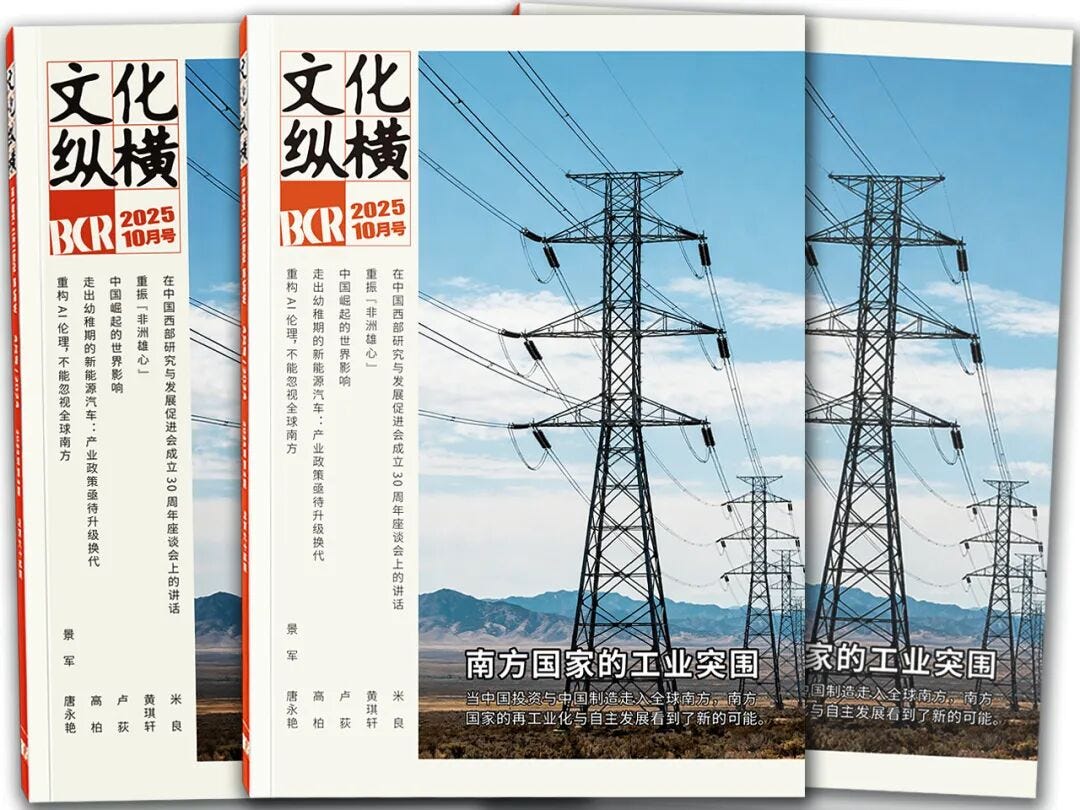
Yet the broader “overcapacity” narrative itself overlooks a deeper structural issue: China’s excess notwithstanding, the root of the malaise lies in global investment shortage. As Chinese political economist Lu Di argued in an interview with Beijing Cultural Review (文化纵横) — an increasingly visible magazine focused on Chinese intellectual debates — published on its WeChat blog on Oct. 30, well before much of the recent Western coverage, the world is suffering from chronic under-investment outside China, not Chinese over-investment:
The insufficiency of development space worldwide is due to slow income growth; and one important reason for slow income growth is insufficient investment. The problem we face today is worldwide insufficient investment, not excessive investment. Whether China has excessive investment or occupies too large a share of worldwide demand is debatable. But worldwide insufficient demand is mainly caused by factors outside China — the entire capitalist world has experienced investment stagnation or even decline.
世界范围内的发展空间不足,是因为收入增长缓慢;而收入增长缓慢的一个重要原因,就是投资不足。我们如今面对的问题是世界范围的投资不足,而不是投资过度。中国是否存在投资过度、是否占有过多世界范围的需求份额,这是可以争论的。但是,世界范围的需求不足主要是中国之外的原因导致的——整个资本主义世界出现了投资停滞,乃至下降。
The World Bank’s own analysis reached the same conclusion in 2023, warning that in advanced economies the investment-to-GDP ratio has fallen from around 23 percent before the global financial crisis to roughly 20 percent in 2022, a collapse that has directly weakened aggregate demand and subdued income growth across the OECD.
Between 2000 and 2022, gross capital formation in the OECD dropped from about 25 percent of GDP to 22 percent, while China’s rose to 43 percent. The asymmetry could hardly be starker, and the culpability of the world’s demand shortfall could hardly lie somewhere else.
In 2025, an Oxford study in the Quarterly Journal of Economics models the fallout from these “barriers to international investment frictions,” estimating that they slash the world’s output by about 7 percent while widening the cross-country scatter of capital per worker.
It constitutes a proof that the investment chokehold at the core of the capitalist world is the true global drag, not Beijing’s export engine.
Professor Lu then homes in on the selective outrage of American technocrats like former Treasury Secretary Janet Yellen, who rails against Chinese “overcapacity” in green tech and products while keeping conspicuously silent about surplus capacity in labor-intensive sectors that the West long ago abandoned.
What Yellen targeted was not overcapacity in China’s labour-intensive industries—even if Chinese products conquered the entire world in those fields, they would applaud rather than condemn, according to Lu.
U.S. financial officials accordingly changed their attitude and tone, beginning to harshly accuse China of causing the so-called “global imbalances.” There were even cases where the same person made a 180-degree turn in attitude: when Janet Yellen was Fed Chair (2014–2018), she still praised the “China produces, America consumes” relationship; but when she became Treasury Secretary in the Biden administration (2021–2024), faced with the same reality, she turned to harsh criticism, believing that China had taken too large a share of demand in the global economy, causing various economic difficulties for deficit countries, especially the United States.
美国的财经官员随之转换态度和口风,开始严厉指责中国导致了所谓的“全球经济失衡”。甚至出现了同一个人前后态度180度大扭转的情况:当珍妮特·耶伦担任美联储主席的时候(2014~2018),她还在赞赏“中国生产、美国消费”的经贸关系;但到了她担任拜登政府财政部长的时候(2021~2024),面对同样的现实,她却转换为严厉的批判,认为中国在全球经济中占有了过多的需求份额,导致逆差国家,特别是美国出现各种各样的经济困难。
And according to EMBER, a non-profit energy think tank, and the World Economic Forum (WEF), China’s lead in solar and batteries, evident in its 2024 deployment of 360 gigawatts of wind and solar capacity, over half the world’s total, acts as a dis-inflationary gift, lowering costs for importers and aiding the energy transition, can hardly be dismissed as purely predatory practice:
EMBER: China Energy Transition Review 2025
These investments in the clean energy future are driving dramatic cost reductions across the world in key technologies such as wind turbines, solar panels, storage batteries and electric vehicles... Accelerating deployment of renewables, grids and storage in China... are rapidly bringing China itself towards a peak in energy-related fossil fuel use, while also reducing costs and accelerating uptake of clean electro-technologies in other countries.
The central challenge is ensuring that renewable energy’s low generation costs lowers total system costs and consumer prices rather than increasing them... In 2024 alone, China installed 360 gigawatts (GW) of wind and solar capacity. That’s more than half of global additions that year... This transformation has also driven the rise of new technologies and business models, from battery storage... to electric vehicles.
2. Who is really pulling up the ladder?
Subramanian says one way China has accomplished this is through shrinking profit margins. Another, he explained in a discussion this month with Taimur Baig, chief global economist at Singapore’s DBS Group, is by substituting robots for higher-cost workers. But China also has failed to “vacate” market share by maintaining policy “distortions,” ranging from an undervalued exchange rate to pure dumping, he said.
“Deliberate policy choices that prevent poorer countries from climbing the development ladder” lie behind China’s dominance, Chatterjee and Subramanian concluded. -- Bloomberg
Bloomberg accuses China of hogging low-end manufacturing, “pulling the ladder up” on poorer nations, per the economists Shoumitro Chatterjee and Arvind Subramanian. The Journal concurs, claiming Beijing deviates from the paths of Germany, Japan or South Korea, which vacated basic industries for those at the lower rung of the development ladder.
This ladder metaphor, however, is fundamentally flawed. China has in fact actively enabled the rise of many in the Global South. Professor Lu counters that China has run trade deficits with developing countries since the early 2010s, only recently flipping to surpluses, while offshoring labor-intensive production to Vietnam, Bangladesh, and Ethiopia.
“Before 2012, China did indeed have a fully comprehensive industrial structure... But at the same time, China began to undergo a transformation in trade structure... our labor-intensive export-oriented industries began to migrate on a large scale and systematically to Vietnam, Cambodia, Bangladesh, Ethiopia... Therefore, in this sense, China has not squeezed other countries’ development space.”
“2012年之前,中国确实是产业结构全覆盖……大量研究表明,其他发展中国家的纺织、服装、玩具……确实曾经受到中国的竞争压力。但与此同时,中国开始发生贸易结构的转型,我们开始出口资本和技术密集型产品,并且比重不断上升,我们的劳动密集型出口导向的产业则开始大规模、系统性地迁往越南、柬埔寨、孟加拉、埃塞俄比亚等发展中国家。因此,在这个意义上也没有发生中国以自身全覆盖的产业链挤压其他国家发展空间的事。”
An East Asia Forum August 2024 analysis seconds this, noting that “China’s large markets and proximity offer ASEAN substantial benefits as a source of investment and an export market, from reductions in production costs through supply chain integration.”
The New York Times, in a September 2025 report on China’s Africa exports, highlights a $60 billion surplus but also surging infrastructure deals that boost local growth, which is indicative of something far from ladder-pulling.
The real hurdle, Lu argues, lies in Western investment atrophy, not Chinese dominance. In a 2024 Project Syndicate column, Harvard economist Dani Rodrik argues that China’s massive subsidies for green tech are not the “beggar-thy-neighbor” strategy the West claims. Rather, they are “enrich-thy-neighbor” policies that help slash clean energy prices, hasten the shift away from fossil fuels, and fill the void left by inadequate carbon pricing. China’s edge, Professor Rodrik believes, stems largely from productivity gains and innovation spillovers, instead of deliberately harming trading partners.
3. The “insecurity” mis-argument
China is developing all of these goods. Soon it will make them, and export them, itself. “Well, how can you blame us,” the conversation usually continued, after agreeing on China’s desire for self-sufficiency, “when you see how the US uses export controls as a weapon to contain us and keep us down? You need to understand the deep sense of insecurity that China feels.”
That is reasonable enough and blame does not come into it. But it leads to the following point, which I put to my interlocutors and put to you now: if China does not want to buy anything from us in trade, then how can we trade with China? This is not a threat but a simple statement of fact. -- FT
The Financial Times attributes China’s self-sufficiency drive to a “deep sense of insecurity” post-sanctions, dismissing it as paranoia.
But as part of the democratic West, they didn’t fear economic interdependence nor seek to eliminate imports. And as they moved up the value chain, they allowed lower-end manufacturing to migrate to poorer countries.
Those countries “were driven by a desire for prosperity,” said Rush Doshi, a China expert who served on President Joe Biden’s National Security Council. “China is driven by a fortress mentality and sees industrial dominance as key to wealth and power. These are longstanding goals deeply rooted in nationalism and the Communist Party.” -- WSJ
The Journal, citing Rush Doshi, frames it as a “fortress mentality” rooted in nationalism, contrasting it with prosperity-driven Western models.
“A very simple example: the profits of American high-tech companies such as Apple, Microsoft, Amazon, Google, and Meta mainly flow into various kinds of financial speculation, especially used to buy back their own shares... rather than being used for reinvestment to promote industrial upgrading. China is different; the most striking example is Huawei... In Keynesian terms, capital in developed countries is simply ‘on strike’.”
“很简单的例子,苹果、微软、亚马逊、谷歌、Meta这些美国高科技公司,它们的利润主要进入了各种各样的金融投机活动,特别是用来回购自己公司的股票……而不是用来投资再生产,推动产业升级。中国则不同,最鲜明的例子是华为。华为将主要的利润用来再投资,所以才能逐步动摇、侵蚀美国公司的垄断租金。按照凯恩斯理论的说法,发达国家的资本在‘怠工’。”
Lu reverses the logic of this argument: in his view, it is the West that exhibits a deeper sense of insecurity, reflecting the erosion of long-standing monopoly rents and a diminished capacity to extract rents amid their inability to re-invest productively in the world.
A 2025 Al Jazeera commentary makes a similar point, arguing that Western criticism of China has intensified because its corporate profits are being squeezed as China’s economic development has brought up the price of its labor while its technological development is breaking longstanding monopolies and may give other developing countries alternative suppliers for necessary goods at more affordable prices.
Within Western academia, there is broad acknowledgment that U.S. export controls have been a major driver of China’s push for technological self-reliance—an adaptation shaped more by necessity than by any intent to disrupt.
4. The coming world of two camps
China’s next five-year plan should temper any hope of change. Consumption is on the priority list, at number three. Items one and two are manufacturing and technology. That leaves one difficult solution and one bad solution for Europe. The difficult solution is to become more competitive and find new sources of value, as the US does with its technology industry. -- FT
Both the Financial Times and Bloomberg pieces deliver the same grim verdict: since Beijing shows no intention of re-balancing toward consumption, letting its currency appreciate uninterrupted, or abandoning industrial subsidies, the rest of the world has no choice but large-scale protectionism.
Usually, if one major global economy grows faster, it lifts all — or at least many — boats. But that’s not the case with what’s going on in China, Goldman’s Joseph Briggs, Megan Peters and Sarah Dong wrote in a recent note titled “Beggar Thy Neighbor.”
While there should be some positives, such as downward pressure on global prices that allows central banks to cut interest rates further, net-net, China’s “spillovers to other countries are more likely to be negative,” the team wrote. They added that China’s supply “may crowd out” production in other nations. -- Bloomberg
Europe, in particular, is told it faces a binary: protect or perish. Goldman calls China’s “spillovers to other countries are more likely to be negative,” and it “may crowd out” production in other nations.
It is, in effect, akin to saying out loud that China’s surplus is a deliberate act of keeping everyone else down, leaving tariffs and subsidies wars as the only rational response left.
Lu rejects this prognosis root and branch:
In such a situation, if developed countries wish to maintain their existing mode of capital accumulation, they must cut ties with China. Because they already know that China cannot be their ‘little partner,’ content to remain relatively underdeveloped and voluntarily contribute its production fruits to developed countries. Moreover, if China continues its current development trajectory, it will continuously erode the monopoly rents on which developed countries survive. Even in monetary and financial terms, their monopoly position is being shaken, albeit to a lesser degree. Politically, global capitalism cannot accommodate China as a member, especially not allowing it to become a developed country—according to the Western establishment’s judgment, the Earth’s resources cannot bear it.
“在这样的情况下,如果发达国家希望继续维持已有的资本积累模式的话,它们就必须跟中国切割。因为它们已经知道,中国是不可能作为它们的‘小伙伴’,甘于停留在相对而言不发达的状况、自愿把生产成果贡献给发达国家的。不止如此,如果中国按这样的发展势头继续发展的话,会不断削弱发达国家赖以生存的垄断租金。其实,哪怕是货币金融意义上,发达国家的垄断地位也正在被动摇,虽然程度没有那么高。在政治上,世界资本主义也容纳不了中国作为它的一个成员,特别是不可能让中国成为一个发达国家——按照西方建制的判断,地球的资源也承受不起。”
The eventual bifurcation of the world economy into “two camps” is probable, Lu acknowledges, but not because China is unwilling to engage within existing rules. Rather, he suggests, it reflects a growing reluctance — and in some cases an institutional incapacity — within the West to accommodate the consequences of genuinely competitive catch-up by a latecomer that does not accept a permanently subordinate role.
The West can only choose to decouple from China and try to suppress China as much as possible… However, this will be a long process of evolution, because the West is now also highly dependent on productive activities related to China and can only gradually ‘decouple’… Therefore, for some time to come, a fundamental transformation of the world political order is unlikely… What is more likely to happen is that the world will split into two camps: one camp dominated by developed countries, and one camp dominated by China… The vast Global South countries, including some European countries, may maintain relationships of varying degrees with both cores in trade, production, finance, currency, and other fields. The camp with China as the core should form more equal relationships, while the camp with the United States as the core will still maintain hierarchical relationships.
西方只能选择跟中国切割,尽量打压中国。但是,这将是一个漫长的演变过程,因为现在西方也高度依赖与中国相关的生产性活动,只能逐步与中国‘脱钩’。……未来一段时间,可能不会发生世界政治秩序的根本性改造……更有可能出现的情况是,世界将变成两个阵营,一个是发达国家主导的阵营,一个是中国主导的阵营……广大的全球南方国家,包括一部分欧洲国家,在贸易、生产、金融、货币等领域,可能会同时与两个核心保持不同程度的关系。以中国为核心的阵营应该会形成更平等的关系,以美国为核心的阵营则仍然会保持等级性的关系。”
According to Lu, much of the Western policy establishment operates as if China cannot be permitted to reach the status of a fully developed economy, given that their own model of accumulation relies on preserving certain monopoly rents that China’s rise is now eroding. In this reading, distancing from China becomes a strategic response, even as the process will be long and painful as they remain deeply dependent on China’s productive apparatus. The political decision behind this momentum, Lu suggests, has already been made.
The intensity of Western reactions to China’s trade surplus reveals more about the vulnerabilities of their own growth model than about China’s intentions. After decades of championing open markets, established powers now find that genuine competition from a latecomer unwilling to remain subordinate can feel destabilizing. Tariffs are no longer corrections, but a bastion to protect an accumulation model that has struggled to invest productively. This panic arrives precisely when China is leading the charge of a clean-energy revolution and opening a genuine second gateway for the Global South. The rules-based order is being jettisoned the moment it threatens to work for someone else.
Two camps are indeed coming into being, but not because Beijing refuses to consume more. They are forming because they behave as if the planet is unable to support another billion population at high-income levels, and that the exclusivity of technological rents must remain in the hands of a few. China’s growth is making both propositions moot. The coming decade will reveal who still believes prosperity can expand, and who prefers isolation.
About the Sources:
Lu Di (卢荻) (or Dic Lo) is Professor of Political Economy at Lingnan College, Sun Yat-sen University, and the director of the Political Economy Research Institute at the university. He has been with the School of Oriental and African Studies (SOAS) University of London since 1994, serving as a lecturer in the Department of Economics.
A scholar in development economics, the Chinese economy, and the political economy of globalization, he has published extensively in high-impact English-language journals including the Cambridge Journal of Economics, China Quarterly, and Journal of Post Keynesian Economics. He has also received grants from National Social Science Foundation of China to explore the political economy of Socialist China in the perspectives of global-comparative studies.
Beijing Cultural Review (文化纵横) is a bimonthly Chinese magazine founded in 2008. The magazine publishes long-form essays that integrate economics, international relations, history, and philosophy. It regularly features extended interviews with prominent scholars and in-depth analyses of global and strategic issues. An English selection has also circulated online for international readers, though its official status is unclear. The journal is widely cited in Chinese academia and policy circles.
Yes, that is what West is doing because of domestic economic and political issues, it is easy to blame China.
This is the most lucid rebuttal to the Goldman Sachs narrative I've seen.
Professor Lu Di nails the core dynamic: It's not 'Chinese Overcapacity'; it's 'Western Capital Strike.'
As a supply chain auditor, I see the physical proof of this every day:
The West: Apple/Microsoft pour billions into stock buybacks (Financial Engineering).
China: Huawei/BYD pour billions into R.I.C.E. (Redundant Infrastructure & Capacity Engineering).
The result is a massive 'Capex Gap.' While the West optimized for ROE (Return on Equity), China optimized for ROC (Return on Complexity).
Now, the West calls China's output 'Predatory,' but in reality, it is just the mathematical outcome of compounding reinvestment vs. compounding financialization.
The 'Two Camps' theory is correct, but not just politically. We are splitting into an 'Industrial Camp' (High Capex/Low Margin) and a 'Rentier Camp' (Low Capex/High Margin). The Arbitrageur's job is to sit in the middle.
👉 I analyze how this 'Capex Gap' creates specific arbitrage opportunities in my latest report. Subscribe (https://substack.com/@chinarbitrageur? ) to see the numbers.