


On December 29, the Chinese People’s Liberation Army (PLA) staged a Taiwan-encircling military exercise codenamed “Justice Mission 2025.” It was the latest example of a new normal established since Beijing launched the first such chokehold-style drill in the wake of Nancy Pelosi’s provocative visit to Taiwan in 2022. Immediately after a record-breaking U.S. arms sale to Taiwan, the latest drill pushed the exercise areas closer to the island than ever before, with the nearest exercise area reportedly just over ten kilometers away.
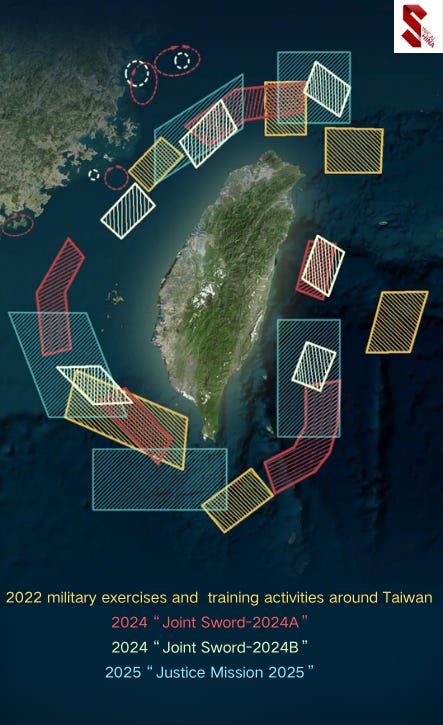
The PLA Eastern Theater Command lavished some of the most advanced models in its arsenal — fighter jets, bombers, drones, destroyers, along with long-range ground-based firepower — jointly ringing in the New Year for the swaggering Taiwan authorities.
Drill of Unprecedented Scale
This isn’t the first time the PLA has carried out exercises around Taiwan. So the more interesting question may be what, if anything, stands out about this round compared with earlier ones. On the very day the drill took place, several academics from PLA-affiliated research institutes gave high-profile on-camera interviews, sharing their views on what they saw as the key features of the exercise.
“Closer to the island of Taiwan than ever before”
Zhang Chi, a professor from the National Defense University of China, noted the exercise areas in this round were “positioned closer to Taiwan’s main island than in previous drills.” After the exercises began, PLA naval and air forces moved in rapidly from multiple directions, establishing what was described as an integrated air-sea control posture around the island.
Compared with previous drills, the configuration reflects a more comprehensive, close-in posture, underscoring comprehensive coverage and integrated blockade-and-strike capabilities.
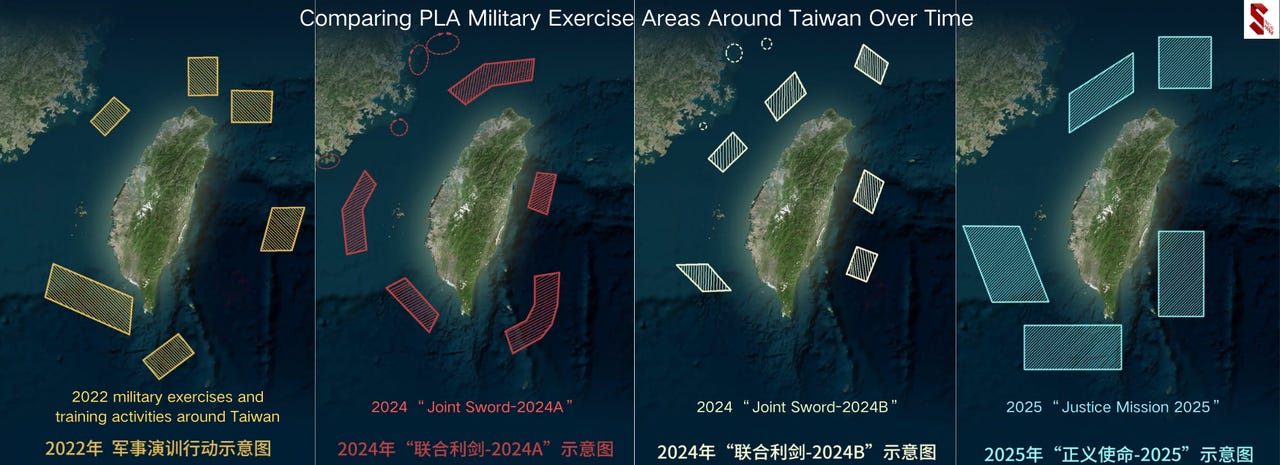
[Note: Based on the Chinese-language maps released by the Chinese military for several rounds of exercises around Taiwan since 2022, we have produced an English version for your reference. The military exercises code-named “Strait Thunder–2025A,” conducted in April this year in the central and southern areas of the Taiwan Strait, are not included in the above illustration, as we were unable to find any officially released, comparable maps of the exercise areas.]
“Combat operations from the outset”
Prof. Zhang noted that the most notable feature of Monday’s drill was “combat operations from the outset”:
This marked a clear departure from PLA’s previous drills in the Taiwan Strait, particularly the series of exercises conducted between 2022 and the first half of 2025. In previous drills, the PLA typically followed a phased escalation approach — first deploying forces and establishing operational postures, before gradually progressing to live-fire activities. This time, however, live-fire operations began almost immediately, with key combat vessels conducting naval gunfire drills.
Coincidentally, one day before PLA’s military exercise, the Taiwan leader Lai Ching-te appeared in an interview, proclaiming that it was “the lack of military capabilities” that deterred Beijing from resolving the Taiwan question by military means. He touted the so-called “porcupine strategy,” long hailed as a panacea for Taiwan’s security conundrum. PLA’s fresh drill posture inadvertently served as a real-time rebuttal.
“Most critical lifelines”
Meng Xiangqing, also a professor from the National Defense University, explained why the deployment of drill forces is basically positioned along Taiwan’s most critical lifelines. He first offered a concise and pointed assessment of Taiwan’s geography:
The island has a relatively small land area, with mountainous terrain, rivers, and rolling hills, and is long from north to south but narrow from east to west. As a result, Taiwan lacks strategic depth, is ill-suited for prolonged conflict, and is severely constrained by a shortage of strategic resources.
On this basis, he concluded that maritime transport routes — as well as energy and supply lines — are of critical importance to Taiwan. He then went on to explain why the five exercise areas were positioned to correspond precisely to what he described as Taiwan’s “most critical lifelines”:
The two northern zones were positioned close to the waters off the Keelung Port, effectively forming a blockade of the port. The two southern zones were positioned adjacent to the Kaohsiung–Zuoying maritime and airspace, severing Taiwan’s largest sea routes and placing vital military bases in a “shut-the-door-and-hit-the-dog” squeeze.
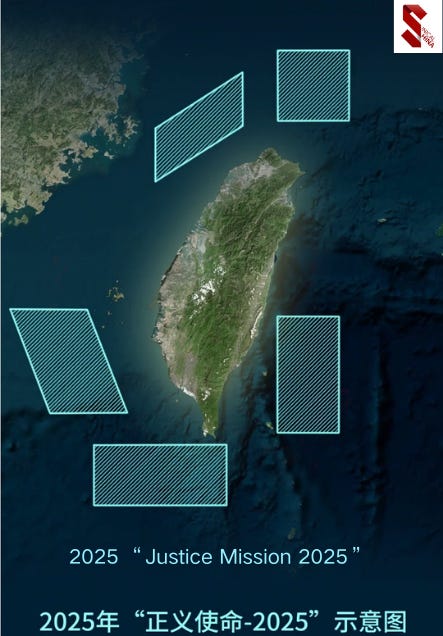
Deployed east of the island, another zone targeted the main eastern access route for external support, showcasing the PLA’s ability to block outside intervention. Overall, the exercises underscored an evolving approach centered on close-in containment and integrated blockade-and-strike operations, external access denial and coordinated sea–air interdiction across multiple ranges.
“Precision strikes”
Another feature of this round of military exercises listed by Prof. Zhang is “precision strikes.” Zhang noted that PLA units tracked and targeted mobile targets across the island, carrying out deterrent precision strikes that left offensive weapons purchased from external forces with nowhere to hide and under constant threat of destruction.
The Arms Deal That Flared
The rationale behind the exercise was made explicit from the outset. On Dec. 29, Xinhua published a commentator article that led by pointing to recent U.S. arms sales to Taiwan:
The U.S. Defense Security Cooperation Agency announced arms sales to Taiwan worth about $11 billion, and the Democratic Progressive Party (DPP) authorities were quick to express their gratitude. Lai Ching-te has presented what critics describe as a “pledge of allegiance” to Washington, committing to raising Taiwan’s defense budget to 5 percent of GDP by 2030 and planning to spend NT$1.25 trillion over the next eight years on arms purchases from the United States.
The commentary stressed that “bottom lines and red lines must not be crossed,” and described the exercise as a stern warning against “Taiwan Independence” separatist forces and external interference, and a legitimate and necessary action to safeguard China’s sovereignty and national unity.
According to Reuters, the arms package covers eight items, including HIMARS rocket systems, howitzers, Javelin anti-tank missiles, Altius loitering munition drones, as well as parts and support for other equipment. HIMARS, in particular, has at times been widely described as a potential game-changing weapon in the Russia–Ukraine conflict.
Fu Zhengnan, an expert with the PLA’s Academy of Military Science, believed the arms sale in question had been provocative and dangerous in three respects:
It is an escalation in procurement scope. The U.S. military sales package to Taiwan totals a staggering $11.1 billion, making it the largest arms sale to the island to date.
It is an escalation of strategic intent. Unlike previous sales that focused mainly on defensive systems, this package is largely offensive in nature, violating the three China-U.S. joint communiqués, especially the August 17 Communiqué of 1982.
It is an escalation toward systemic confrontation. Taiwan’s latest procurement covers not just offensive weapons, but also the Taiwan Tactical Network and Force Awareness Application Suite, effectively linking the island’s military operational systems with U.S. networks. These acquisitions heighten the risk of direct confrontation between U.S. and Chinese forces.
By the time China and the U.S. established formal diplomatic relations in 1979, the issue of Washington’s arms sales to the Taiwan regime had yet to be resolved. In 1982, following multiple rounds of negotiations, the two sides issued what later was known as the August 17 Communiqué of 1982.
China made clear that U.S. arms sales to Taiwan could not be justified by the Taiwan Relations Act (TRA), nor could the U.S. commitments on arms sales be made conditional on China’s policy of seeking a peaceful resolution of the Taiwan question. Against this backdrop, the two sides reached an agreement on the communiqué, in which the United States promised:
...that its arms sales to Taiwan will not exceed, either in qualitative or in quantitative terms, the level of those supplied in recent years since the establishment of diplomatic relations between the United States and China, and that it intends to reduce gradually its sales of arms to Taiwan, leading over a period of time to a final resolution.
In the eyes of Beijing, the whopping $11.1 billion arms sale can only be deemed as a flagrant breach of the past commitments and unilateral alteration of the status quo across the Taiwan Strait.
Hours after the drill began, the official WeChat account of the Department of North American and Oceanian Affairs, China’s Ministry of Foreign Affairs, published a commentary in reference to the August 17 Communiqué of 1982. The account, named Kuanguang Taipingyang (literally translated as the “Wide Pacific Ocean”), sought to appeal to Washington’s reason:
Sino-U.S. confrontation over the Taiwan question does not serve America’s interests. Now that the two countries share broad common interests and vast potential for cooperation, they have every reason to be partners and friends, in order to secure mutual benefits and common prosperity. The United States, in addressing numerous domestic challenges and pressing international issues, cannot do without China’s support. But this is predicated on its respect for China’s core interests. Seeking cooperation with China on the one hand while incessantly undermining China’s core interests on the other simply does not work.
Wang Wenjuan, a researcher with the PLA’s Academy of Military Science, further justified the drill on the grounds of legal principles:
Principles such as respect for state sovereignty and non-interference in internal affairs are the basic norms of contemporary international law, enshrined and reaffirmed in the UN Charter. The 1970 Declaration on Principles of International Law explicitly prohibits acts of secession and forbids both direct and indirect interference. In 1965 and 1981, the international community adopted the Declaration on the Inadmissibility of Intervention in the Domestic Affairs of States and the Protection of Their Independence and Sovereignty, and the Declaration on the Inadmissibility of Intervention and Interference in the Internal Affairs of States, respectively. It is therefore clear that actions aimed at splitting a state or interfering in its domestic affairs constitute serious violations of international law.
It was also noted that Beijing has, in recent years, come to make Taiwan’s unification a legally binding commitment by establishing a framework of laws that include the Constitution, National Security Law, National Defense Law, and Anti-Secession Law. Safeguarding territorial integrity is therefore regarded as “a sacred responsibility of all Chinese, Taiwan compatriots included.”
PLA’s Offensive on Media Front
Beyond conventional military measures, the PLA simultaneously rolled out an upgraded psychological warfare campaign, deploying a barrage of videos and visual content aimed at “Taiwan independence” separatist forces.
It develops a distinctive way of packaging exercise-related content — one that resonates strongly with the general public and, in some cases, draws directly on popular expressions circulating in the Chinese mainland.
One example is a short video released by the Eastern Theater Command on the day of the exercise, titled “So Close, So Beautiful — Anytime to Taipei” (《这么近那么美 随时到台北》). The video runs for less than a minute. For those familiar with Chinese internet memes, the wording is instantly recognizable as a variation on a tourism slogan launched in 2019 by north China’s Hebei Province: “So close, So Beautiful — A Weekend in Hebei.” (”这么近 那么美 周末到河北”)
Notably, the Eastern Theater Command replaced “weekend” with “anytime,” a subtle but deliberate change. This appears to echo what many military analysts have emphasized—that the exercises were intended to demonstrate the PLA’s ability to shift rapidly from training to combat readiness.
Although the slogan’s final line refers specifically to Taipei, the video’s visual design suggests a broader message. In the Chinese characters for “Taipei,” one stroke of the character bei (北) is highlighted in red and shaped like the island of Taiwan, implying that the PLA’s operational reach extends beyond Taipei to cover the entire island.
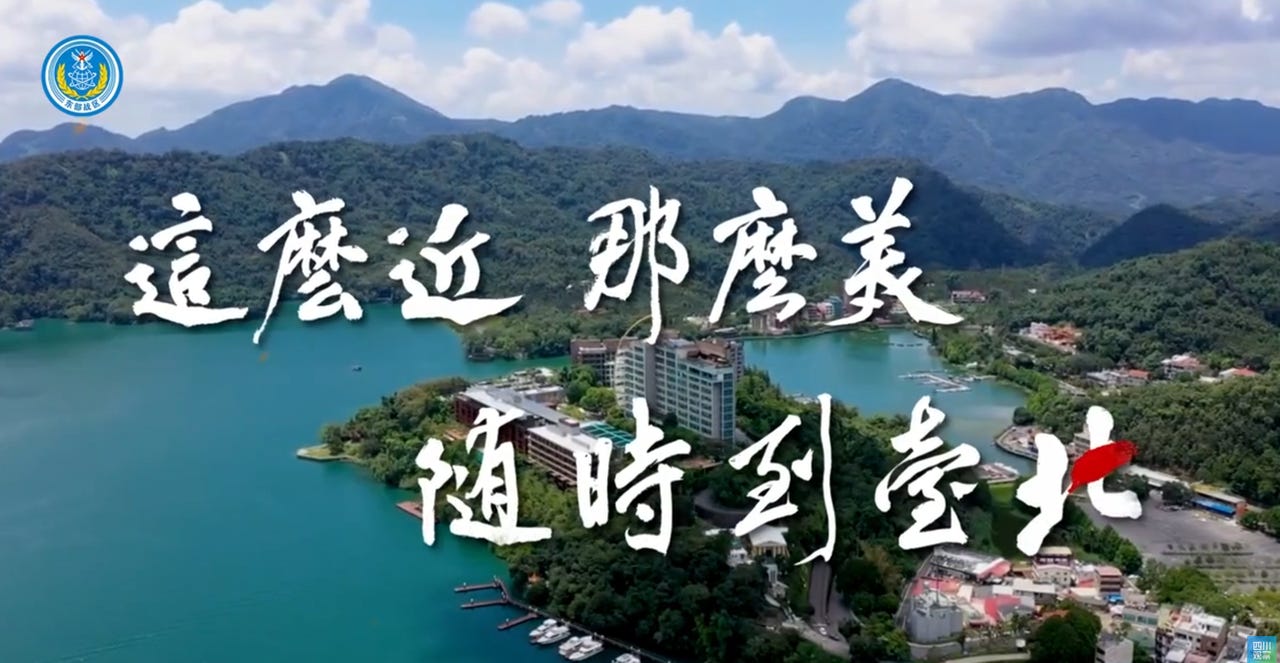
Another moment that drew attention comes at around the 41–42 second mark, when footage shows an aerial view over Taipei’s urban area. The same footage also appeared that evening on Xinwen Lianbo, China’s flagship nightly news program. According to China Central Television, the images were captured by a PLA drone. How close that drone came to Taipei, however, is a question best left to military experts.
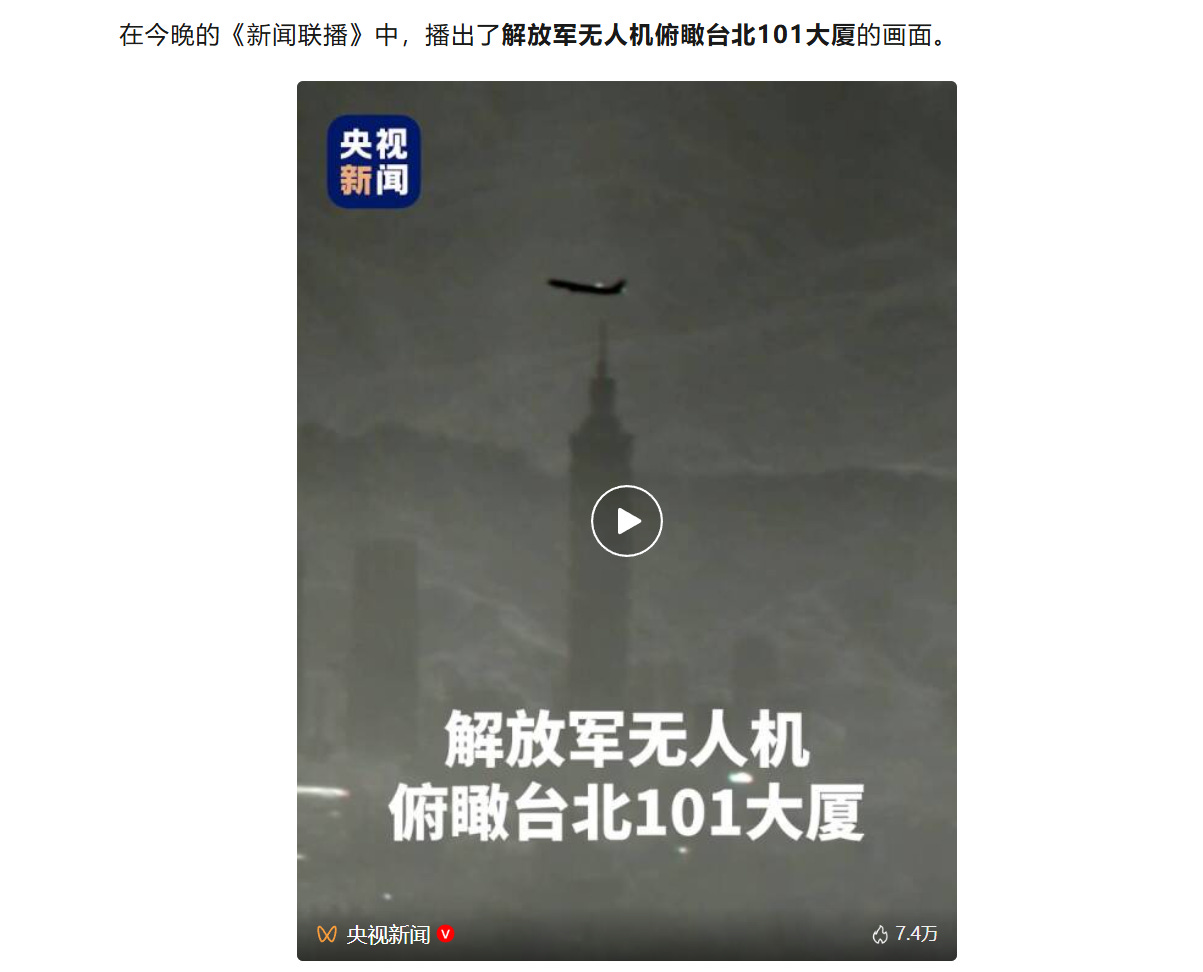
The video’s soundtrack is also striking. Rather than a solemn or martial tone, it adopts a light, youthful, almost “cute” musical style — suggesting a carefully considered approach to audience engagement.
For viewers who prefer a more traditional and hard-edged military aesthetic, the Eastern Theater Command also released a separate exercise video titled “Intercept, Break Through, Strike at Distance” (《驱歼 破击 远袭》), which focuses on live-action training scenes and carries a much more serious combat tone.
In addition to videos, posters have been another visual highlight. One widely circulated poster, titled “Shield of Justice — Breaking Limits and Dispelling Delusions“ (《正义之盾 破限除妄》), features the slogan: “Any external interference that strikes the shield will be destroyed.” The image depicts a shield emblazoned with a Great Wall motif blocking incoming aircraft and warships, leaving little ambiguity about its intended message.
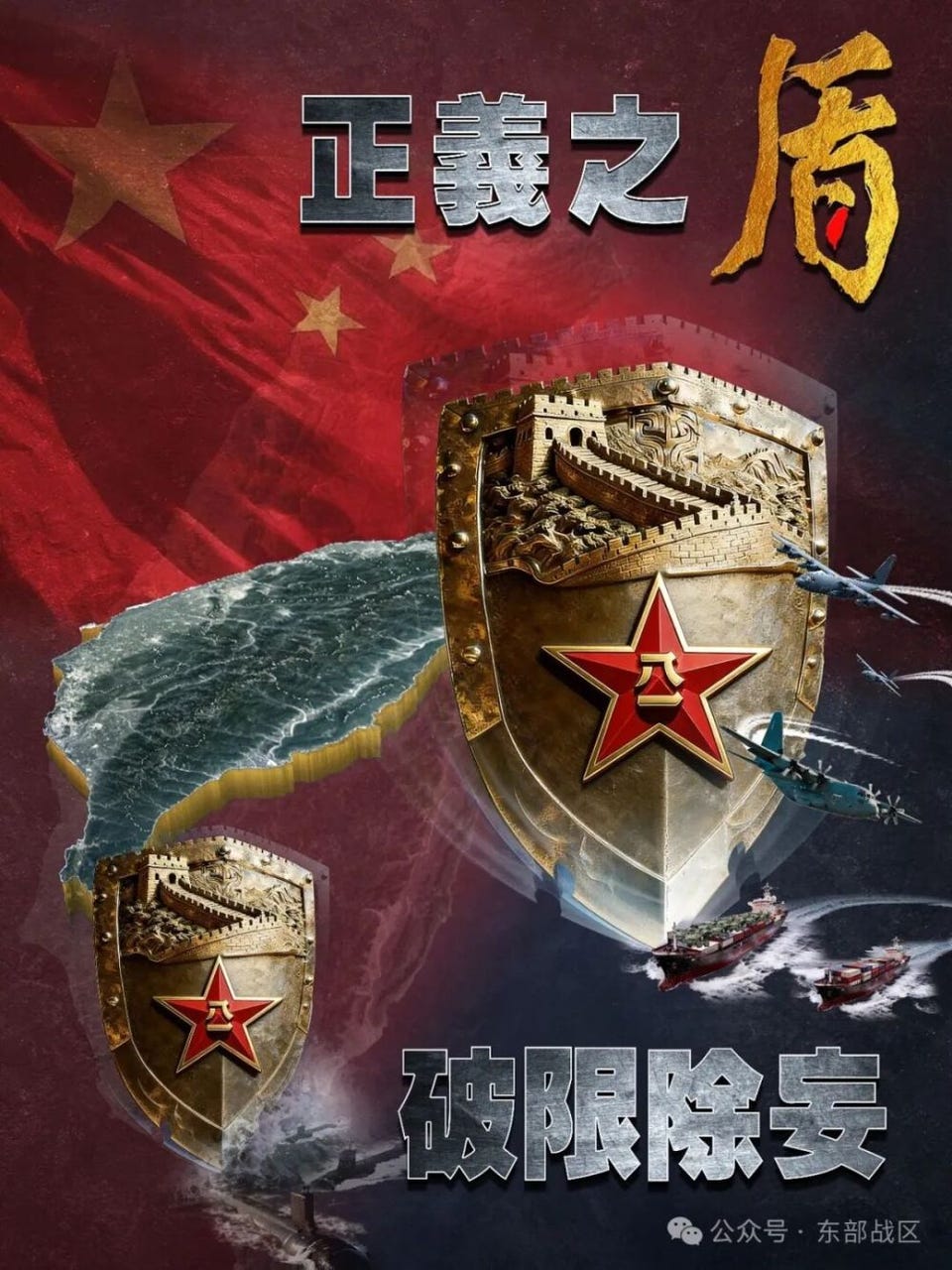
As with the video, visual symbolism is layered into the design: in the character for “shield” (盾) at the top right corner, a red stroke again takes the shape of Taiwan. Taken together, the posters and videos show a high degree of visual and thematic consistency in how the exercises are being framed.
This unusually expressive style highlights Beijing’s unequivocal stance on resolving the Taiwan question: “We will continue to strive for peaceful reunification with the greatest sincerity and the utmost effort, but we will never promise to renounce the use of force, reserving the option of taking all measures necessary.”
Read our previous story for a historical cautionary tale of Beijing’s use of force on Taiwan:
How Beijing Took Taiwan by Force, the Last Time

In the year 1683, two consequential battles took place respectively in the West and East. In the wake of a siege-breaking bloodbath outside Vienna, King Jan III Sobieski of Poland wrote to his queen-consort about how his winged hussars had saved Christendom from the invincible Ottoman janissary. Thousands of miles away in the high-walled Forbidden City …
I saw the video clip. Such a creative response to US provocations!😃