


In its first issue of the new year, the Communist Party of China’s official publication Qiushi featured a commentary loaded with new assessments and policy initiatives in the country’s real estate sector. Titled “Improving and Stabilizing Expectations in China’s Real Estate Market,” the article explicitly notes that “the conventional real estate development model has reached its limits,” while reaffirming “real estate’s strong attributes as a financial asset” and that “it remains a bedrock of the national economy.”

The fact that this piece appeared in Qiushi is in itself a noteworthy policy signal. Far from a typical policy outlet, Qiushi serves as the Party’s premier theoretical journal publication and is directly overseen by the Communist Party of China Central Committee. Its predecessor, Red Flag (红旗), was launched by Mao Zedong in 1958 with a distinctly revolutionary style. It was renamed Qiushi (求是) in 1988 by Deng Xiaoping, who personally inscribed its title—a symbolic gesture underscoring the Party’s commitment to applying the principle of “seeking truth from facts (实事求是)” to update and revamp the traditional socialist framework in step with the Deng-initiated reform and opening-up drive.
Today, Qiushi often publishes exclusive excerpts of Xi Jinping’s remarks delivered at key political meetings. It also serves as a platform for policy commentary that blends official cues with academic analysis, offering insight into China’s governance approaches and broader policy priorities. Its choice of topics and framing of arguments typically reflect policy consensus forged through extensive deliberation between policymakers and the academic community. The prominence given to real estate in Qiushi’s first issue of the year is, therefore, highly symbolic. Beyond directly addressing market concerns, it signals that the top leadership remains committed to stabilizing expectations and ensuring the orderly functioning of the property market.
The article is authored by Zhong Tingjun, who is the deputy director of the Policy Research Center at the Ministry of Housing and Urban-Rural Development and also a PhD supervisor at the Chinese Academy of Social Sciences. This dual background in policy research and academia, in turn, shapes the role the article is intended to play: grounded in concrete housing issues—ranging from affordable housing programs that provide low-cost units to those in need, to urban renewal initiatives aimed at modernizing city districts, and to the renovation of aging residential communities—the piece is less a practical policy manual than an officially authorized effort to explain and clarify the structural changes taking place in China’s real estate sector.
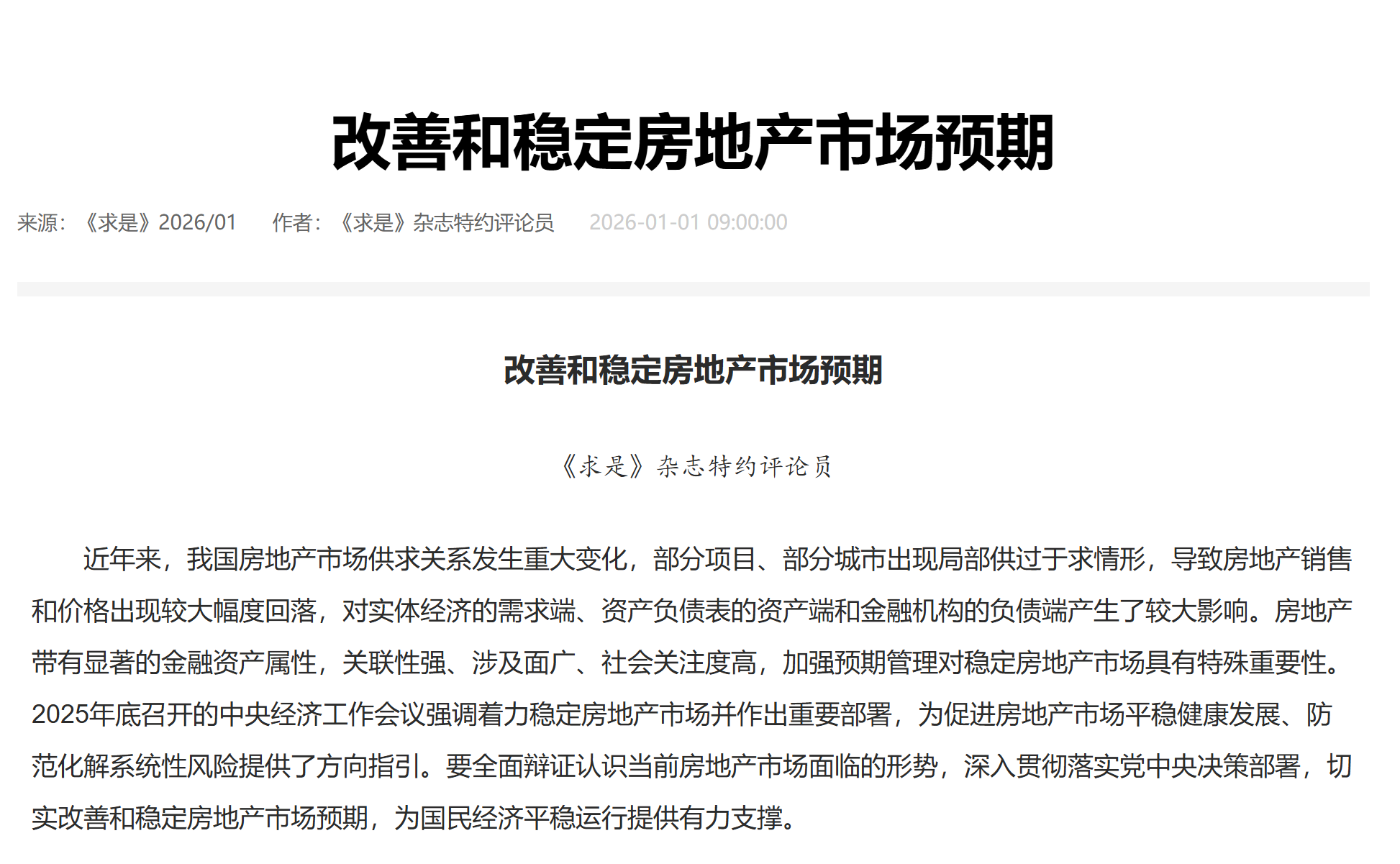
China’s old real estate model has obviously reached its endpoint. But how will the government adjust a sector that once powered the country’s economic growth and now struggles to achieve a “soft landing” in the coming year? One could take cues from this piece of Qiushi article.
Signal One: Official Jettison of the Old Real Estate Model
The very title of the article—“Improving and Stabilizing Expectations in China’s Real Estate Market”—points to the core and most persistent challenge in China’s current property policy framework. Policy support has been steadily intensified since the central government explicitly called for efforts to “reverse the downturn of and stabilize the real estate market” in 2024. Nevertheless, at the national level, this goal is far from attained.
It is against this backdrop that the article delivers an unambiguous assessment of where China’s real estate sector now stands. It identifies three structural shifts that together define the current phase of the market.
First, overall housing shortages have given way to basic balance in total supply, accompanied by structural shortages—particularly in affordable housing—leaving new urban residents and young people facing relatively heavy housing burdens. Second, residents’ demand has broadly evolved from concerns about “having a roof over their heads” to “whether the quality of housing is good enough,” with a growing desire for better living standards. Third, the traditional model of “high debt, high leverage, and high turnover” championed by developers is no longer sustainable; the industry must now transition toward low-debt, low-leverage, and reasonable-return operations, upgrading from quasi-manufacturing to integrated “product-service-operation” models.
一是住房总量短缺转为总量基本平衡、结构性供给不足,特别是保障性住房相对不足,新市民、青年人住房负担较重。二是居民需求总体上从“有没有”向“好不好”转变,对提升居住品质愿望更为强烈。三是房地产企业的“高负债、高杠杆、高周转”模式难以为继,亟待向低负债、低杠杆、合理回报的模式转变,由“类制造业”升级为“产品—服务—运营”一体化。
Building on these observations, the article delivers a candid assessment:
In certain projects and cities, localized oversupply has emerged, triggering pronounced declines in property sales and prices. These corrections, in turn, have exerted significant spillover effects—weakening demand in the real economy, eroding asset values on balance sheets, and placing strain on the liability side of financial institutions.
部分项目、部分城市出现局部供过于求情形,导致房地产销售和价格出现较大幅度回落,对实体经济的需求端、资产负债表的资产端和金融机构的负债端产生了较大影响。
Recent official data help put this diagnosis in context. According to China’s National Bureau of Statistics, real estate development investment fell 15.9% in the first 11 months of 2025. Over the same period, new home sales by floor area declined 7.8%, while sales value dropped by a sharper 11.1%.
The broader demand backdrop remains subdued. China’s retail sales of consumer goods went up 4% year-on-year in the first 11 months of 2025, a modest increase from 3.5% in the same period of 2024, but still well below the 7.2% growth recorded in 2023. Analysts widely interpret the prolonged weakness in China’s property market as a factor weighing on household confidence and consumption, underscoring how developments in real estate continue to reverberate across the macroeconomic landscape.
Beyond documenting the trends, the article draws on a comprehensive set of core indicators to reach a firm and unequivocal conclusion:
Whether viewed through metrics such as household homeownership rates, price-to-income ratios, or price-to-rent ratios—or through facts like the share of real estate-related loans in total bank lending, the proportion of real estate revenues in local government fiscal income, and the weight of housing assets in household wealth—it is abundantly clear that the old real estate development model has reached its limits.
无论从家庭住房拥有率、房价/收入比、房价/租金比等指标看,还是结合房地产相关贷款占银行贷款比重、房地产业相关收入占地方财政收入比重、居民住房财富占家庭总财富比重等事实观察,传统房地产发展模式已经走到了尽头。
Adjusting for demolitions, urban per capita housing floor space reached about 41 square meters by the end of 2024, with average household ownership exceeding 1.1 units. This level of housing penetration indicates that the traditional model—where the sector drives economic growth primarily through large-scale new construction—is nearing its end, as the potential for further expansion in absolute housing demand is increasingly constrained.
While previous central policy documents and key political meetings have frequently referenced the need to “develop a new real estate model” and “promote high‑quality development,” these statements were typically cautious and measured.
For instance, the Resolution adopted at the Third Plenum of the 20th CPC Central Committee called for accelerating the establishment of a new real estate development model, while the communique of the Fourth Plenum emphasized promoting high-quality development across the sector. More recently, the Central Economic Work Conference stressed defusing risks in key areas, with a focus on stabilizing the real estate market. In contrast, the Qiushi article delivers a near‑unvarnished assessment of the old model, signaling that policymakers now have a clear consensus on the structural imbalances reflected in key indicators and that policy discussion is shifting decisively toward accelerating the transition to a new development model.
Signal Two: Stronger Policy Delivery in One Go, No More Drip-Feeding Stimulus
In terms of expectations, policy strength must match market anticipation: deliver the full measure of support in one go, avoiding drip-feeding stimulus that would lock the market forces and government policies in a state of gamesmanship. In terms of policy coordination, the authorities should strengthen consistency assessments. Real estate is significantly influenced by overall expectations regarding the stage of economic development, macroeconomic conditions, and the growth rate of residents’ income. Policies should aim to better satisfy residents’ essential housing needs and diversified improvement demands by lifting relevant restrictive measures, ensuring smooth coordination between new and old policies, and maintaining consistency between real estate policies and the orientation of other macroeconomic policies.
政策预期上,政策力度要符合市场预期,政策要一次性给足,不能采取添油战术,导致市场与政策陷入博弈状态。政策协调上,强化政策一致性评估,房地产受经济发展阶段、宏观经济形势、居民收入增速等整体预期影响明显,要以更好满足居民刚性需求和多样化改善性住房需求为目标,取消相关限制性措施,确保新老政策相互配合,确保房地产政策与其他宏观政策取向一致。
The explicit rejection of “drip-feeding stimulus” is striking. Rare in official real estate rhetoric, it addresses the prolonged policy–market standoffs of recent years, during which incremental measures fell short of reviving market confidence.
In retrospect, China’s property stabilization strategy has largely followed an incremental, calibrated approach. Measures such as selectively loosening purchase restrictions, gradually trimming mortgage rates, and lowering down-payment ratios in specific cities were intended to stabilize the market while mitigating the risk of overheating. In practice, however, this stepwise intervention often prolonged market uncertainty, blunted the effectiveness of individual measures, and fostered a pronounced wait-and-see mindset among buyers and sellers. Market participants became increasingly “policy-desensitized,” delaying decisions in anticipation of the next round of easing, leaving expectations without a clear anchor.
By explicitly discarding this incrementalism, the Qiushi article signals a shift in policy thinking. In a phase of deep adjustment, stabilizing expectations has become a policy objective in its own right. Achieving this requires greater coherence in timing, scale, and coordination, rather than reliance on fragmented, trial-and-error measures.
In 2025, major cities, including Beijing, Shanghai, Guangzhou, Shenzhen, and Hangzhou, rolled out successive rounds of easing—covering purchase eligibility, taxes and fees, and credit conditions. Just one week before the Qiushi article was published, Beijing unveiled its second round of 2025 housing policies. These measures, aimed particularly at non-local families and multi-child households, included allowing families with two or more children to purchase an additional home within the Fifth Ring Road (a major expressway separating central Beijing from suburban districts), reducing the required period of social insurance or income tax records for non-local buyers from three years to two for central districts and from two years to one for suburban areas. The frequency of these adjustments underscores the gap between past practice and the article’s call for more decisive, front-loaded action.
More importantly, a broader set of medium- and long-term reforms is now being rolled out in parallel. In late December 2025, the Ministry of Housing and Urban-Rural Development issued guidelines on improving housing quality, setting out a clear roadmap for “high-quality housing” through 2030. Around the same time, fiscal authorities confirmed that from 2026, VAT on housing transactions will be reduced and streamlined: the rate on homes sold within two years of purchase will be cut from 5% to 3%, while homes held for two years or more will be exempt. These measures directly lower the cost of upgrading and facilitate turnover in the existing housing stock.
Taken together, these policies point in a consistent direction: revitalizing the housing market through institutional adjustments rather than short-term stimulus, activating the secondary housing market, and strengthening linkages between new and existing homes.
Against this backdrop, the call to deliver the full measure of support in one go marks a clear break from the gradualist playbook of the past. It reflects a firmer top-level resolve to stabilize the market, and suggests that future property policies will be more systematic, coherent, and robust in both planning and implementation.
Signal Three: Reaffirming Real Estate’s Role as a “Financial Asset” and “Foundational Industry”
While the article declares that China’s traditional real estate development model has reached its endpoint, it does not diminish the sector’s macroeconomic significance. On the contrary, the author emphasizes that real estate “has strong attributes as a financial asset.” Viewed in the context of the decade-old official principle that “housing is for living in, not for speculation,” the acknowledgment in the Qiushi article seems to reflect a subtle shift in emphasis. In fact, the author’s point is that precisely because of its financial attributes— its extensive interconnections, wide-ranging implications, and high public attention—strengthening expectation management is of paramount importance for stabilizing the market. Greater clarity on the sector’s financial attributes would help guide the market toward a more rational and stable investment environment.
In response to market narratives suggesting that real estate’s importance to the national economy is waning, the article firmly rejects such claims as “lopsided.” The rationale is straightforward:
The sector’s all-encompassing nature spans dozens of upstream and downstream industries—from steel and cement to household appliances and furniture—exerting significant influence on investment, consumption, employment, and other critical economic indicators. It remains the bedrock of the national economy. In 2024, the combined added value of real estate and construction accounted for 13% of GDP and directly created over 70 million jobs.
涉及钢铁、水泥、家电、家具等几十个上下游行业,对投资、消费、就业等关键经济指标均有显著影响,仍然是支撑国民经济的基础产业。2024年,我国房地产业和建筑业增加值占国内生产总值的比重合计达13%,直接带动就业人口超7000万人。
These figures suggest that, although investment in the real estate sector has declined in recent years, it continues to carry substantial economic weight. Areas such as housing services, secondary housing market transactions, and real estate asset management have maintained robust growth, revealing substantial untapped potential. Judging from China’s current stage of urbanization, the transformation of the real estate sector still leaves huge growth potential.
In 2024, China’s urbanization rate reached 67%, yet the urban household registration rate remained below 50%. This gap indicates that housing demand from “new urban residents”—including newly settled rural migrants and recent university graduates—has yet to be fully released; Nearly 40% of urban households have per capita floor space below 30 square meters, and about 7% fall short of 20 square meters. Urban areas alone hold roughly 35 billion square meters of housing stock. Assuming a 2% annual depreciation rate, this will translate into roughly 700 million square meters of annual replacement and renewal demand.
2024年中国常住人口城镇化率为67%,而户籍人口城镇化率不足50%,新落户农民工、新毕业大学生等“新市民”刚性住房需求有待持续释放;我国城镇人均住房建筑面积在30平方米以下的家庭户占比接近40%,约有7%的城镇家庭人均住宅建筑面积尚不足20平方米。目前中国城镇已积累约350亿平方米的住房存量,按照每年2%的折旧率估算,每年将产生约7亿平方米的更新替代需求。
These data also highlight two priorities for demand-side interventions: the rigid housing needs of “new urban residents” and the renewal and upgrading of existing housing stock. Both are closely linked to the “new-type urbanization” (新型城镇化) strategy launched under Xi Jinping’s leadership. This policy framework emphasizes:
A “people-centered” approach. Urbanization is defined primarily by addressing human needs—most notably access to housing, healthcare, and education—rather than by rapidly inflating urbanization rates through the large-scale relocation of rural populations. Within this framework, reform of China’s household registration (hukou) system, which determines access to public services based on place of registration, is envisioned as a gradual process, aligned with the expansion of public service capacity. This approach seeks to avoid urban ghettoization, as seen in cities such as Rio de Janeiro or Johannesburg.
Coordinated and balanced urban growth. The framework prioritizes moderating the expansion of megacities while fostering growth in smaller cities and county seats, thereby narrowing disparities between cities, across regions, and between urban and rural areas.
Enhancing cities’ quality and resilience. Policies promoting new-type urbanization should focus on modernizing urban housing, enhancing disaster resilience, and advancing the transition to green and smart cities.
The article further strengthens the argument for real estate’s continued macroeconomic importance through international comparisons. Data indicate that China’s real estate sector increasingly mirrors the role of property markets in mature economies:
International experience further reinforces this: in developed economies like the United States, United Kingdom, Germany, Japan, and Australia, real estate’s share of GDP still averages above 10%, serving as a vital ballast for economic stability and the primary form of societal wealth.
从国际经验看,美国、英国、德国、日本、澳大利亚等发达国家,目前房地产业增加值占国内生产总值的比重平均都在10%以上,依然是经济保持稳定的重要支撑和社会财富的主要形式。
From 2000 to 2024, Japan and the Republic of Korea built an annualized average of 7.74 and 10.39 new housing units per thousand people, respectively, reflecting sustained momentum in construction. Based on this research, China’s annual demand for new urban and rural housing should fall in the range of 10–14.9 million units, suggesting ample room for growth.
2000—2024年,日本、韩国每千人年均新建住宅分别为7.74套、10.39套,房地产建设强度仍然较高。有关研究机构以此推算,我国城乡每年新建住宅规模应在1000万—1490万套之间,房地产发展仍有不小的市场潜力。
Signal Four: Policy Priorities for Real Estate
While emphasizing that a healthy and stable real estate market is essential for the overall stability of China’s economy, the article offers a measured and pragmatic assessment of the sector’s current situation:
On one hand, high inventories in some cities need time for absorption and market clearance. On the other hand, the sector harbors great development potential, though converting that potential into drivers of growth and confidence also requires a process. Risk prevention and contingency plans must be prepared in advance, since debt levels among developers remain high, and the possibility of bankruptcy or restructuring for individual enterprises cannot be ruled out.
一些城市库存还比较高,消化库存、市场出清需要时间;另一方面,房地产发展潜力和空间巨大,但转化为当前发展动力和信心也需要一个过程。目前房地产企业债务仍然较高,不排除个别企业仍有破产重组的可能,要未雨绸缪,有效做好应对。
Based on this assessment, the article provides more operational guidance on policy priorities.
On the demand side, the focus is on stabilizing expectations and removing constraints:
Policies should aim to better satisfy residents’ essential housing needs and diversified improvement demands by lifting relevant restrictive measures, ensuring smooth coordination between new and old policies, and maintaining consistency between real estate policies and the orientation of other macroeconomic policies.
要以更好满足居民刚性需求和多样化改善性住房需求为目标,取消相关限制性措施,确保新老政策相互配合,确保房地产政策与其他宏观政策取向一致。
On the supply side, the policy orientation is toward structural adjustment rather than unchecked expansion:
On the supply side, strict control of new increments must work in tandem with revitalization of existing stock. Acquisitions of commercial inventory should be encouraged, primarily for uses such as affordable housing, while orderly advancing the construction of “good homes.” Radical reforms must be implemented in real estate development methods, aiding enterprises in accelerating shifts from reliance on new-home sales to greater emphasis on holding properties and providing high-quality, diversified residential services.
做好供给管理。供给端要严控增量、盘活存量,鼓励收购存量商品房主要用于保障性住房等合理用途,同时有序推动“好房子”建设。彻底改变房地产开发方式,支持房企加快从以新房销售为主向更多持有物业、提供高品质多样化居住服务转型。
On the institutional side, policy efforts should be put to “lay the groundwork” for the new development model:
The construction of the new model should serve as the guiding force for promoting high-quality development in real estate. This requires refinement of foundational institutions for commercial housing development, financing, and sales, careful timing of the rollout of these institutions, deepening reforms to the housing provident fund system, and facilitating a smooth transition between old and new models. The country should encourage continued expansion of the scope of real estate investment trusts (REITs), conduct pilot explorations of mechanisms for supplementary payment of land premiums on land with expired usage terms, and stabilize the investment expectations and confidence of social capital.
要完善商品房开发、融资、销售等基础制度,合理把握各项基础制度出台时机,深化住房公积金制度改革,推动新旧模式平稳转换。鼓励不动产投资信托基金继续扩大范围,对使用年限超期的土地试点探索建立土地出让金补缴机制,稳定社会资本的投资预期和投资信心。
The article further emphasizes that housing represents the largest and most significant asset for ordinary families, and housing prices directly affect public interests and attract widespread attention—a point that helps explain the widespread attention the piece has received.
A report from the China Index Academy indicates that China’s real estate market continued to “adjust” throughout 2025. In the first 11 months of 2025, the average price of second-hand residential properties across 100 major cities fell by a cumulative 7.46%. The secondary housing market remains characterized by a “volume-for-price” dynamic, meaning that sellers often lower prices to encourage transactions, while high inventory keeps overall prices under pressure. In terms of inventory clearance, as of the end of November, the 50 major cities in the sample had an average clearance period of 22.2 months.
These figures underscore that challenges persist in China’s property sector. Yet the article’s unusually candid language also signals that, as the traditional development model exits, the authorities are actively working to secure the breathing space needed for a smooth market transition. While obstacles remain, 2026 still offers policymakers leeway to act, and they are making concerted efforts to reinforce confidence and facilitate a return to stability in the real estate market.
Tan Yixiao is a Xinhua journalist. Currently based in Beijing, she spent three years in the U.S. covering politics and international affairs. Email: yixiaotan@live.cn
Xu Zeyu, founder of Sinical China, is a journalist with Xinhua News Agency. Email: xuzeyuphilip@gmail.com
For more stories on China’s recent adjustment to the property industry:
Off the Plan: China’s Housing Paradigm Shift in New Five-Year Blueprint

Once the roaring driver of China’s meteoric economic rise, the property sector now stands at a defining turning point. In China’s recently released proposals for the 15th Five-Year Plan (2026-2030), the real estate industry, previously placed within chapters on consumption, services, and urbanization in the country’s medium-term blueprints, has been rep…