


On December 17, an article appeared on the official WeChat account of the Zhejiang Provincial Publicity Department, bearing the cautionary title “Beware of the ‘1644 Historical View’ Disrupting Our Rhythm”—a distinctively Chinese internet slang for manipulating public opinion often in biased and misleading ways. Within hours, it was republished and heavily cited across major news outlets and official accounts, indicating a coordinated push-back against a growing viral online discourse that has captivated, and increasingly alarmed, segments of China’s digital space. Here are the opening lines:
Recently, the so-called “1644 historical view” is gaining traction online. It contends that the demise of the Ming dynasty at the hands of Manchus in 1644 and the subsequent establishment of the Qing dynasty (1644-1912) represented “a fatal rupture in Chinese civilization.” In this narrative, Qing is not regarded as a legitimate successor of Chinese dynasties but a “foreign colonial power,” and the entire Qing history is open to a complete rejection because Qing’s misrule led to China’s weakness and suffering during the century of humiliation.
近来,所谓的“1644史观”在网上持续引发热议。该论调的核心主张包括,将1644年明朝灭亡、清军入关视为“华夏文明的中断”,将清朝定位为“外来殖民政权”,并衍生出对清朝历史全盘否定的评价,将近代中国积贫积弱、遭受列强欺凌的根源归咎于清朝的统治。
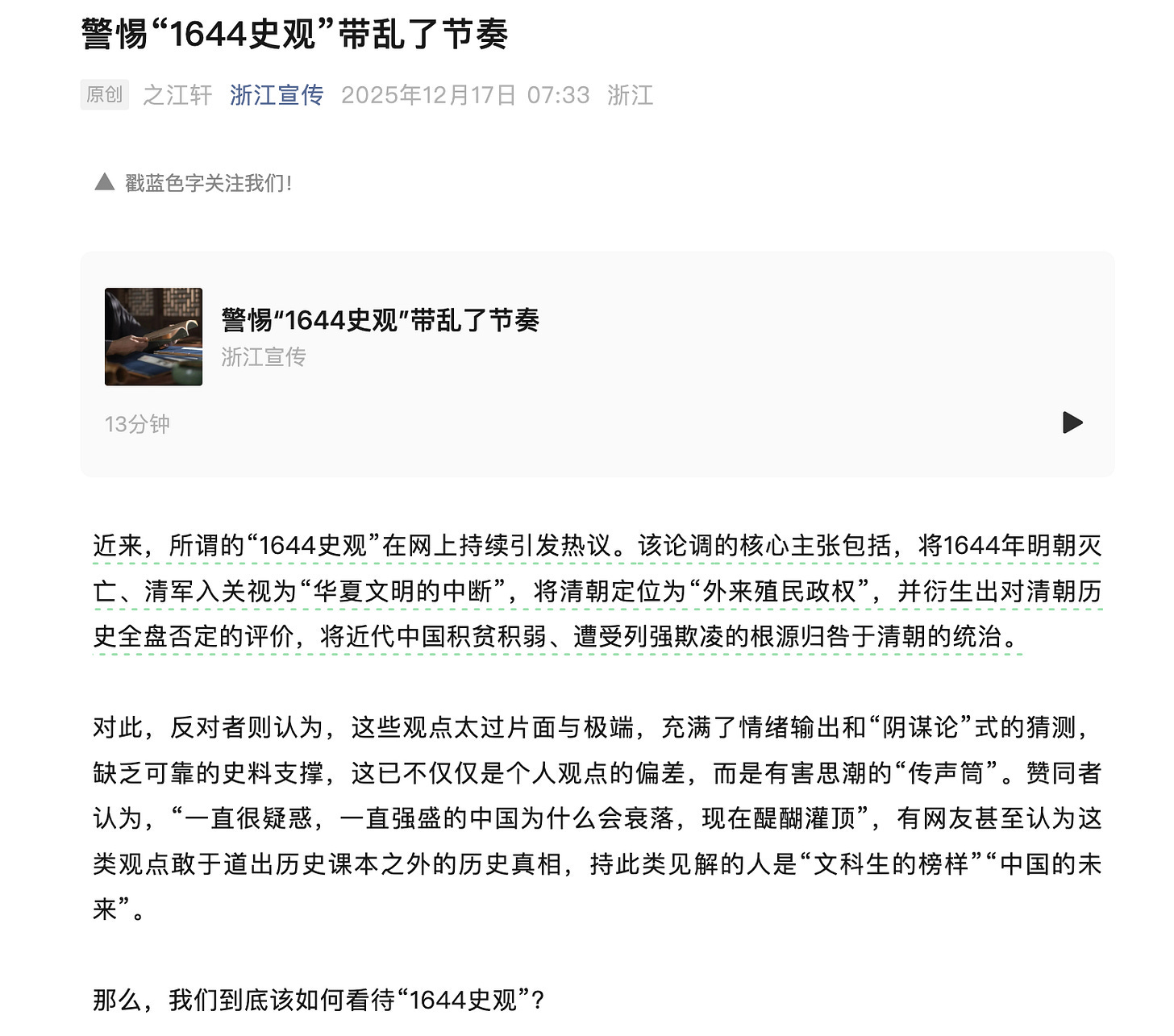
The original piece was issued by the publicity arm of Zhejiang provincial authorities, whose WeChat account Zhejiang Xuanchuan has a reputation for its outspoken and progressive leanings. The account earned nationwide prominence by publishing an article titled “The People Are the Priority, Not Anti-Covid Measures” (“人民至上”,不是“防疫至上”) in November 2022, in a measured yet unmistakable rebuke of local authorities clamoring for further policy outreach during the height of the draconian Covid containment drive. That piece allegedly nudged policymakers in the direction of ending the “zero-Covid” policy.
The latest article argues that the sentiment-arousing narrative against Manchus is not merely historically simplistic but politically divisive, risking stirring ethnic divisions at home while echoing external narratives designed to cast doubt on the legitimacy of China’s modern multi-ethnic state.
The “1644 historical view,” a far cry from novel scholarly invention, is a “version” of the interpretation of history popularized through bite-sized videos and heated threads on the comment section. Its core claim lies in the idea that the Manchu’s entry into the Chinese capital interrupted an otherwise rolling wheel of Chinese advancement. Proponents hail it as an ingenious unmasking of truths absent from school textbooks, while critics dismiss it as emotional venting dressed up as insightful revelation.
Yet beyond our perceptual knowledge of history, we must also approach it with reason. The study of history bears directly on profound questions: where the Chinese nation has come from, and where it is headed. Passion for history is admirable; every individual’s enthusiasm for China’s past deserves affirmation. But when it comes to interpreting historical facts and drawing conclusions, we need clear-headed awareness and a basic understanding of the subject—rather than simply echoing popular opinion. Regrettably, certain social media accounts exploit historical snippets, peddle emotive takes, and engineer controversies purely to gain popularity, gravely misleading public understanding. They act either out of ignorance or deliberate distortion.
不过,我们在对历史有感性的认识之外,也需要对历史有理性的理解。对历史的研究,关系着中华民族从何处来、往何处去的重大问题。热爱历史是好事,每个人对中国历史的热忱都是值得肯定的。但如果涉及对历史事实、历史结论的解析,也需要保持清醒认知,具备基本的历史素养,而不能人云亦云。然而,有些自媒体通过截取碎片化史料、输出情绪化观点、制造争议性话题来收割流量,严重误导认知。他们要么是对历史无知,要么是在刻意歪曲历史。
The Zhejiang piece emphatically unpacks the appeal of this narrative. It acknowledges the genuine patriotic fervor from which it derives, as many adherents to the narrative recoil from memories of the late-Qing’s incompetence and the atrocities it committed against the Han majority, channeling frustration over China’s historical humiliations into anti-Qing sentiment.
In today’s fiercely competitive society, where the pressures of life have intensified, some individuals project their real-world feelings of helplessness and frustration onto discussions of history. This serves as a psychological defense mechanism: by criticizing—or even vilifying—a dynasty long vanished, and by rejecting history in one sweeping gesture, they achieve a fleeting sense of emotional catharsis.
时至今日,该论调在互联网语境下获得关注,除了认知层面的因素外,还有着复杂且深刻的心理根源。比如,面临现实压力的情绪宣泄。在竞争激烈、生活压力倍增的当代社会,部分人将现实中的无力感与挫折感,代入到对历史的讨论中。这是一种心理防御机制——通过批判甚至辱骂早已不存在的王朝,通过对历史的单向度否定,获得短暂的情绪释放。
However, empathy has its limits. The piece warns that if this sentiment is allowed to go unchecked, it can veer into the realm of absurdity and, more dangerously, into a narrow ethnic populism that treats Manchus, Mongols, and other ethnic minorities as outsiders to the storyline that drives Chinese history forward. And such exclusion, the piece argues, plays into the hands of foreign narratives long deployed to undermine China’s territorial and historical integrity.
Consider, for instance, how this view flies in the face of historical context. The “1644 historical view” approaches the past with modern notions of the nation-state. In 17th century Chinese society, perceptual distinctions between “civilized” Hua and “barbarian” Yi certainly existed, but ordinary people’s political loyalties were far more tied to region, culture, and dynasty than to ethnicity. Once the Qing rulers established themselves in the Central Plains, they swiftly assumed the mantle of “lords of China,” with successive emperors explicitly positioning themselves as universal sovereigns over “All Under Heaven.” They respected the political and cultural traditions of the China’s heartland and never pursued an exclusionary regime centered on their own ethnicity. Overemphasizing Manchu-Han antagonism blurs the essential nature of dynastic succession as a transfer of power, and risks devolving into a parochial Han-centrism.
比如,违背历史语境。“1644史观”用现代的民族国家概念切割历史。在17世纪的中国社会,“夷夏之辨”虽然存在,但普通民众的政治认同更多是地域性、文化性和王朝性的。清朝统治者入主中原后,迅速采纳“中国之主”的政治身份,历任皇帝都明确将自己定位为“天下共主”,尊重中原的政治传统和文化传统,并未追求排外的“本民族政权”。过分强调满汉对立,模糊了王朝更替本质上还是政权更迭,可能会演化为狭隘的汉族中心主义。
The bashing of Han-centrism has a more profound political origin. China enshrined its latest edition of the ethnic policy in 2017 as “promoting the sense of community for the Chinese nation” (铸牢中华民族共同体意识), which downplays the core position of the Han ethnic, which accounts for over 90% of the Chinese population, and emphasizes the shared identities among all ethnic groups living on China’s soil. It later became an integral part of “Xi Jinping Thought on Culture,” formally established in 2023 as one of Xi’s six highest-level governance philosophies that are qualified to be referred to as “Thought” in official rhetoric. You are free to check out our article “Why China Adopts Culture as Political Doctrine” for a more detailed analysis on this subject.
Take its denial of the resilience of civilization for instance. The extraordinary inclusiveness and continuity of Chinese civilization have been proven time and again through history. From the Northern Wei to the Yuan, when northern nomadic peoples entered the Central Plains and founded their own dynasties, the outcome was never a rupture in civilization but rather ongoing cultural fusion and political integration. The Qing followed this very pattern: after entering the realm, it promptly adopted Ming’s political institutions and preserved core elements of Chinese civilization—Chinese characters, the civil-service examination system, Confucian thought—demonstrating unbroken continuity at both institutional and civilizational levels.
比如,否定文明韧性。中华文明强大的包容性和连续性在历史上多次得到验证。从北魏到元朝,北方民族进入中原建立政权的结果从未导致“文明中断”,而是不断促进新的文化融合与政治整合。清朝延续了这一历史模式,入关后迅速沿袭明朝政治制度,继承了汉字、科举制度、儒家思想等中华文明的核心元素,这些都体现了文明和制度层面的连续性。
The piece voices against the latest trend on the Internet that some content creators monetize anti-Qing sentiment by turning it into marketable internet traffic. Among them was Chigua Mengzhu (吃瓜蒙主), who had a significant presence on China’s YouTube-wannabe Bilibili. She rose to prominence in late 2025 with livestreams and video clips offering acerbic comments on the Qing dynasty’s legacy from a staunch Han-centric perspective. Her commentary centers on cultural revival and national confidence, often blending historical narratives and contemporary social issues.
Supporters praise her for amplifying grassroots voices and challenging orthodox views, while critics decry her for promoting unsubstantiated claims to fuel ethnic division. Her clips frequently attract hundreds of thousands of views, triggering contentious debates among audiences, though some content has been removed amid escalating controversy.
Some claims in this narrative have strayed so far from historical discussion that they have become mere noise-shaped, amusingly absurd gossip. For example: “The Manchu gave away the photolithography technology documented in the Yongle Encyclopedia (The world’s largest pre-modern compendium of knowledge commissioned by the emperor Yongle of Ming in the early 15th century) to the West—that’s why we are struggling with the West’s choke-hold on key technologies today.” Or: “When Lin Daiyu buries flowers, the ‘flowers’ she’s really burying stand for ‘China’ itself—the character for flower subtly evoking ‘Hua,’ the classical name for the Chinese realm.” (Lin Daiyu was the emotionally fragile heroine from Dream of the Red Chamber, the eighteenth-century masterpiece widely regarded as China’s greatest novel, and Lin’s famous flower-burying scene serves as a poignant meditation on transience and personal sorrow. However, fringe readings reinterpret it as coded mourning for the fallen Ming under Qing rule.)
And those who uphold this view alleged that Chen Xiaoxu, the actress who brought this character to life in a hit TV series in the 1980s, knew this truth forty years before the rest of us; she wasn’t acting on the silver screen—she was truly weeping for our vast and ancient civilization.”
They claimed in an equally absurd way that the word “invention”, or “Fa Ming” in Mandarin pronunciation, referred to the “Ming” dynasty, because all Chinese scientific advancements sprang from the Ming Era’s Yongle Encyclopedia, that boundless treasure house of Chinese knowledge.
还有些观点已经脱离讨论历史的范畴,变成了“吃瓜”言论,令人啼笑皆非。比如,“满清把《永乐大典》上的光刻机技术送给了西方,导致我们现在还在被卡脖子。”“黛玉葬花,葬的‘花’原来是‘华’。陈晓旭早我们40年知道真相,所以她在剧中不是演的,是真正在为我泱泱华夏而哭。”“发明,它不叫发东,不叫发西,不叫发秦,不叫发唐,不叫发宋,也不叫发元,唯独它叫发明,因为它都起源于《永乐大典》,中华文明的知识宝库。”
The article also explicitly links this growing domestic trend to the Western scholarly movement known as “New Qing History,” which was given rise by a school of American historians. Since the 1990s, this cohort has highlighted the Qing’s distinctive Manchu identity, often portraying it as a conquering regime rather than a fully sinicized successor state while deliberately playing down their role in the continuity of Chinese civilization.
Some could argue that while these works have, to a certain extent, enriched global understanding of the Qing through Manchu-language sources and global comparisons, they have long provoked unease in China for seemingly eroding cultural continuity and political integration.
Even more alarming, this so-called “1644 historical view” unwittingly echoes certain overseas narratives designed to dismantle the continuity of Chinese history, lending ammunition to arguments that seek to undermine the historical legitimacy of China as a unified multi-ethnic nation. Take, for example, the school of “New Qing History” that emerged in the United States. Some of its arguments deliberately spotlight the Qing’s “Manchu characteristics,” depicting it as a non-Han conquest dynasty while downplaying its ties to Chinese historical traditions. The implicit logic is to sever the Qing dynasty from the broader Chinese narrative, thereby supplying grounds for separatist claims.
更需要引起警惕的是,所谓的“1644史观”与境外某些旨在解构中国历史连续性的叙事形成了呼应,为那些试图否定中国统一多民族国家历史合法性的论述提供口实。比如,兴起于美国的“新清史”研究,其部分论点刻意强调清朝的“满洲特性”,将其描绘为“非汉人的征服王朝”,淡化清朝与中国历史传统的连续性。这种论述的潜在逻辑是割裂清朝与中国历史的关系,为某些分裂论调提供依据。
This is no abstract and abstruse academic debate. In today’s China, the official historiography has placed great emphasis on forging a shared sense of belonging across the country’s 56 ethnic groups. The Qing’s incorporation of Taiwan, Xinjiang, Tibet, and Mongolia is routinely cited as the historical foundation for modern borders. Portraying Qing as a foreign occupier threatens to unravel that consensus.
Transcending binary oppositions and construct an inclusive narrative. What we need is a tolerant, integrative account of the Chinese nation’s history—one that decisively moves past simplistic dichotomies like “Sinicization” versus “barbarization,” or “conquest” versus “subjugation.” The vitality of Chinese civilization shines precisely in the dynamic process by which diverse peoples, through collision and difference, have blended and learned from one another across the centuries. The Qing’s place in history ought to be assessed within this broader story of multiple ethnic groups co-writing China’s past. Such a narrative fully acknowledges the contributions and cultural distinctiveness of each people while sharply illuminating the overarching integrity and unity of Chinese civilization—an indispensable cognitive foundation for forging a strong sense of community among the Chinese nation.
超越二元对立,构建包容叙事。我们需要构建一种包容、整合的中华民族历史叙事,彻底超越“汉化”与“胡化”、“征服”与“被征服”的简单二元框架。中华文明强大的生命力,正体现于历史上各民族在碰撞中交融、在差异中互鉴的动态过程。清朝的历史地位,应被置于多民族共同书写中国史的整体叙事中来评价。这种叙事既能充分承认各民族的历史贡献与文化特性,又能鲜明彰显中华文明的整体性与统一性,是铸牢中华民族共同体意识必不可少的历史认知基础。
The piece advocated for a more inclusive historical narrative, one that transcends the binary portrayal of “sinicization” versus “barbarization” and instead celebrates the dynamic interweaving of contributions from peoples of different origins as proof of the undying vitality of Chinese civilization. It demonstrates an interesting turn in rhetoric as the “sinicization” narrative was equally dismissed as a biased discourse, even if it was once the archrival academic genre vis-à-vis the “New Qing History.” The two sets of opposing arguments were brought into full view amid the famous polemic between Ho Ping-ti and Evelyn S. Rawski in the late 1990s, and the impact lasts till today. The rhetorical shift showcased the official inclination to elevate the “sense of community of the Chinese nation” as an overarching principle that rises above either perspective.
Bewaring the instrumentalization of history, we should uphold scholarly rigor. Historical inquiry can legitimately proceed from varied perspectives, but it must always rest on solid sources and meticulous methodology. We should be wary of history being co-opted by any political agenda or irrational sentiment. This means firmly opposing tendencies like those in “New Qing History” that deliberately sever the Qing dynasty from China’s historical continuity for academic-political ends, even as we consciously resist domestic online expressions that, under the guise of “restoring truth,” in fact erode shared consensus through emotional outbursts. Only by insisting on the scrupulous use of evidence and logic—returning history to its proper domain as a discipline—can we effectively counter attempts, domestic or foreign, to distort China’s historical narrative and safeguard the scientific integrity and seriousness of its study.
警惕历史工具化,坚守学术理性。历史研究可以有不同视角,但必须建立在扎实史料和严谨方法基础上,警惕历史被任何形式的政治意图或非理性情绪所工具化。我们既要坚决反对如“新清史”等刻意割裂中国历史连续性的学术政治化倾向,也要自觉抵制国内网络空间中以“还原真相”为名、行撕裂共识之实的历史情绪化表达。唯有坚持史料与逻辑的严谨性,让历史回归历史学的本来领域,才能有效抵御内外各种试图扭曲中国历史叙事的企图,守护历史研究的科学性与严肃性。
An episode like this reveals something much deeper. The Party is actively forging a modern national identity rooted in the “community of the Chinese nation.” This civilization-centered concept, epitomized in Xi Jinping’s vision of “Chinese modern civilization,” is intended to transcend narrow ethnic, regional, or sub-cultural divisions. Therefore, narratives that pit the Han majority against minorities, whether through Han-centrism or “New Qing history”, are increasingly treated by authorities as direct challenges.
Furthermore, amid growing social discontent from economic slowdown and tempered outlooks, outlets for catharsis via memes and satirical humor are sometimes tolerated. But content that threatens political stability or ethnic solidarity crosses a firm red line, and it will undoubtedly trigger a swift official response.
Amid a chorus of commentary, the Zhejiang piece stands out for its tone. Instead of outright denunciation, it elects for a measured yet unequivocal rebuttal steeped in scholarly rigor and historical evidence. It acknowledges public sentiment while methodically steering the narrative back toward official lines.
The piece’s widespread adoption and positive reception also signal a deeper societal consensus. Rejecting a populist backslide and divisive ethno-nationalism remains a core value in Chinese society, one that the country’s leadership is determined to promote and reinforce.
Xu Zeyu, founder of Sinical China, is a senior journalist with Xinhua News Agency. Email: xuzeyuphilip@gmail.com
Tian Zijun is a Xinhua journalist based in Guangxi Zhuang Autonomous Region. Email: jeremytzj@qq.com
Read the following story for China’s rationale behind incorporating culture into political platforms:
Why China Adopts Culture as Political Doctrine

If one has to pick a word of the year for 2023 that projects the future pattern for China’s policy behaviors, then I would go with “culture” or “civilization.” Earlier this December, President Xi Jinping sent a congratul…
The most interesting aspect of the “1644 historical view” is that, by reinterpreting the actual conditions during periods of foreign rule such as the Yuan and Qing dynasties, one can conclude that the notion of a continuous 5,000-year history is in fact unrealistic. This line of reasoning can further extend to questioning the legitimacy of the Chinese Communist Party’s rule. Given that the CCP is, in essence, rooted in the Soviet system and was supported by the Soviet Union, such arguments are naturally regarded as highly threatening by the authorities, especially in today’s context of significant political and social instability. I believe this is also one of the reasons why such an article would be produced.
It's interesting how you've captured the nuance of official pusback in a system that often seems monolithic from the outside. Your analysis really brings to light the underlying currents of identity politics at play, even when filtered through official channels.