


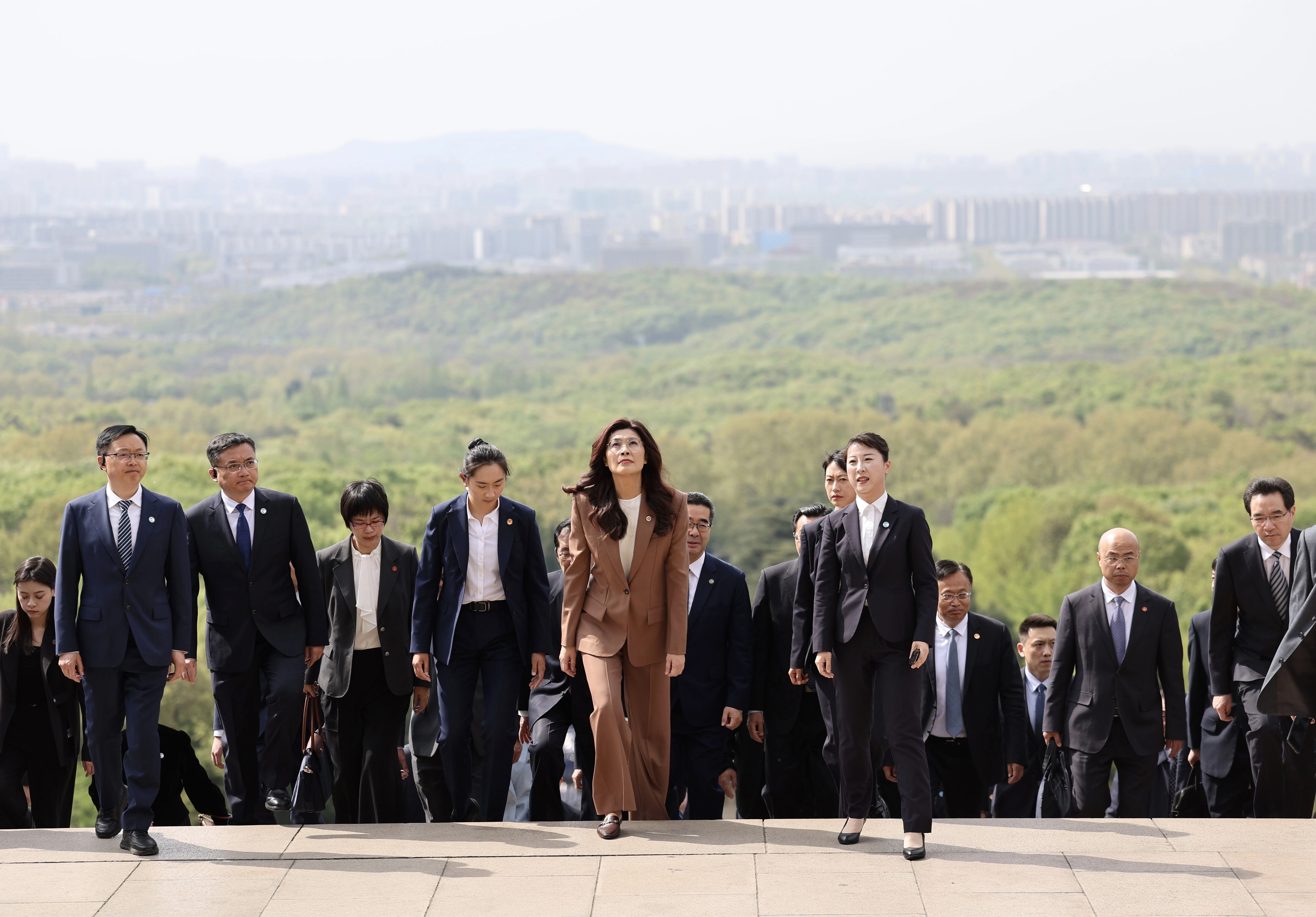
As the first Kuomintang (KMT) party leader to traverse the Taiwan Strait in a decade, Cheng Li-wun greeted mainland officials at Shanghai airport with a remark carrying political undertones: “Shanghai is closer to Taiwan than one would imagine.” The comment appeared to echo the 2005 ice-breaking trip by Lien Chan, who landed in Nanjing as the first KMT chairman to visit the mainland since 1949 and famously said the distance across the Strait was “not that far after all.”
In that landmark trip 21 years ago, Cheng served as the spokesperson of the KMT delegation and witnessed the first act of leadership-level rapprochement with the Communist Party of China (CPC) from a front-row seat. Today, Cheng has returned to the mainland as her party’s chairwoman, seeking to revive communication channels at a moment when cross-Strait relations have reached a precarious nadir. Her visit this time may be less historic, but more pressing.
As she commented on the physical distance of her journey, the political chasm across the Strait is now at its widest in decades. For Cheng, the historical barriers her predecessor once sought to overcome have been replaced by a set of more intractable realities that have locked the Taiwan question into structural tensions: the island’s increasingly toxic political environment, the yawning gap in overall strength across the Strait, and the intensifying great-power competition between China and the United States.
Confronting the Status Quo Disruptor
At a pre-departure press briefing, Cheng said that “attaining peace in the Taiwan Strait is actually not difficult.” The claim doubled as a mission statement of her self-styled “journey for peace.” Yet it hints at a grimmer reality that the island is edging ever closer to the brink of war. Last December, mainland military drills encircling Taiwan came within nine nautical miles of its shores. While this has led Western observers to make a fashion of predicting when Beijing might resort to force, a deeper source of the tensions has often been overlooked: the rise of populism in Taiwan’s politics.
Over the past decade, the island was ruled under the pro-independence Democratic Progressive Party (DPP), which launched a wholesale campaign aimed at manipulating historical narratives and political correctness. The party has played a version of identity politics reminiscent of Zootopia, recasting the KMT party, historically dominated by mainland-originated elites, as the “carnivore” foreign oppressors burdened with an original sin.
Such framing has propelled a distinct “Taiwanese subjectivity” into the mainstream, while the “greater China” idea once firmly upheld by the KMT has been pushed to the political margins. At the end of the last century, when Taiwan just introduced electoral politics, advocacy of “Taiwan independence” was still the ultimate vote loser. Today, however, even politicians in the pan-blue camp (ideologically pro-KMT) find themselves compelled, by electoral logic, to stress a more “local” Taiwanese identity in cross-strait discourse. In this climate, the “1992 Consensus”—the pragmatic formula where both sides of the Strait acknowledge that there is but one China—has been increasingly stigmatized, forcing politicians to skirt around it or render it deliberately ambiguous.
By claiming to restore pride in a shared Chinese identity among Taiwanese, Cheng Li-wun, who assumed the KMT chair last October, has staked her tenure on a refusal to be politically kidnapped by the DPP and sought to put an end to a decade of cross-strait stalemate.
In her meeting with Xi Jinping, she stated publicly that both the KMT and CPC should strengthen their shared political foundation, built on the “1992 Consensus” and opposition to Taiwan independence. She also invited Su Chi to accompany her on the mainland trip. It was Su who, during the KMT’s previous stint in power in 2008, played a pivotal role in enshrining the “1992 Consensus” into official policy.
In Cheng’s pilgrimage to Sun Yat-sen’s Mausoleum in Nanjing, she paid tribute to the figure revered by both the KMT and CPC as a pioneer of China’s revolution. In the speech she emphasized was “written entirely by myself,” Cheng drew a thought-provoking historical parallel: When Sun died in 1925, mourning him on the Chinese mainland could be done “openly and with dignity,” whereas in Japanese-occupied Taiwan at the time, such expressions had to be done “carefully and concealed.” The contrast she suggested appears to mirror today’s politically charged environment in Taiwan, where what the DPP frames as political correctness has come to stigmatize and marginalize identification with China—much as Sun himself.
The genesis of this modern-day identity struggle lies in over a century of unresolved political and military history. Once ceded to Japan in 1895, Taiwan was restored to China in 1945 with the blessing of the Cairo Declaration and Potsdam Proclamation. The Chinese civil war, which began in 1946, culminated three years later in the CPC’s victory on the mainland and the KMT’s retreat to Taiwan, leaving a divided political order in its wake.
To this day, what is widely regarded as the world’s longest-running civil war has never formally been brought to a legal conclusion. Both sides, in their respective constitutions, still claim that the territory of the other side falls within their rightful jurisdiction. A meeting between the two parties in 1992 produced a tacit understanding that both sides adhere to the “one China” principle, even though they might interpret “China” differently in their own political discourses.
A China-centred narrative that preserves shared cross-strait memory has, over the past decade, come under sustained pressure from Taiwan’s DPP authorities. Lai Ching-te, now in office, has pursued what is described as a more explicit form of “de facto Taiwan independence.” The rogue move has eroded mutual trust across the Strait, shattered crisis-management guardrails, and pushed the island further towards military confrontation. Cheng’s visit amounts to a pointed response to such attempts to upend the status quo.
Beijing’s Strategic Patience
Despite a decade of button-pushing by the pro-independence forces in Taipei, Beijing has maintained a posture of strategic patience. The approach was reflected in Xi’s remarks during his talks with Cheng: “We welcome any proposals conducive to the peaceful development of cross-Strait relations and will spare no effort to advance any endeavors that promote such development.”
If Beijing were determined to set the stage for a military resolution—as many in the West have predicted—such conciliatory overtures would be entirely superfluous. Clearly, Beijing still views a peaceful settlement as its primary objective.
Such patience is all the more remarkable given a profound shift in the balance of power between the mainland and Taiwan. The People’s Liberation Army (PLA), whose name remains a literal reminder of the unfinished “liberation” of Taiwan, has over recent decades moved from relative technological backwardness to overwhelming superiority. Had the mainland’s political culture been captured by the same populist sentiment now evident in Taiwan, a military showdown might already have become unavoidable.
A more palpable shift has been economic. When Cheng accompanied Lien Chan on his mainland visit 21 years ago, China’s economy still trailed behind Japan and Germany. Today, it is considered even by the United States as a “near-peer.” Taiwan, whose GDP once amounted to roughly half that of the mainland, has since been overtaken even by the closest mainland province.
Therefore, unlike previous KMT leaders’ visits, which were steeped in culture and history, Cheng’s itinerary was packed with tours of tech frontiers: experiencing a drone-based delivery system, visiting an EV factory, touring an advanced chip foundry, and stepping inside the cabin of a domestically developed large passenger aircraft. The mainland’s global leadership in innovation and integrated industrial chains has now exerted a gravitational pull on the island, challenging the very sectors in which the island once claimed an unassailable comparative advantage 20 years earlier.
As Cheng’s visit drew to a close, Beijing unveiled a fresh package of preferential economic policies. The last such broad package of goodwill measures dates back to the period when the KMT was in power between 2008 and 2016, which was marked by the opening of direct flights and the signing of the ECFA trade agreement. The latest round of concessions, however, is all the more notable, given that earlier rounds fell short of fostering mutual trust amid pushback from the DPP.
However, history has shown that even the greatest measure of strategic patience has its limits. The last time a mainland power resorted to force to unify Taiwan was in 1683. A film commemorating that episode, The Battle of Penghu, is due for release this year—an implicit reminder that the final campaign was the culmination of two decades of delay, evasion, and reversal by the regime that then held Taiwan, in its fitful negotiations with the Qing court. Nearly half a century into Beijing’s proposal of “peaceful unification” after it ceased the bombardment of Kinmen in 1979, the mainland has consistently maintained that it will not renounce the use of force.
Cheng Li-wun repeatedly returned to the theme of “peace” throughout her trip. During a visit to Shanghai’s Yangshan Port, she remarked: “If peace is given enough time, anything is possible.” The question is what that time of peace, long or short, will be used for. If the mainland must continue to contend with a Taiwan drifting ever further from the “one China” principle and more closely aligning with America’s strategy to contain Beijing, the window for peace opened by this visit may prove fleeting.
Beyond a Pawn
One striking aspect of Cheng Li-wun’s visit is its timing: she arrived in Beijing a month before Donald Trump, whose own trip was reportedly delayed by a crisis in another strait. Cheng’s decision to engage the mainland before heading to the United States sets her apart from many in Taiwan who have outsourced their strategic thinking to Washington. She advocates a more measured and rational approach: “Taiwan should not be a passive object of geopolitical pressure, valued only for what others project onto it.”
The past decade’s intensification of great-power competition between the United States and China has coincided with the DPP’s second spell in office in Taiwan. During this period, Washington has become more explicit in treating the island as a pawn in its effort to constrain Beijing.
Since 2018, the US has begun to promote what is sometimes described as a “denial strategy,” steadily normalizing the sale of more advanced weaponry to Taiwan in a blatant disregard of the 1982 U.S.-China Joint Communique. The goal has been to fashion Taiwan into a heavily armed “porcupine” or “hedgehog,” designed to maximize the costs of any mainland military action, even at the risk to the island itself. Last December’s record-breaking $11.1bn arms package represented the latest peak of this approach.
Under Donald Trump, the United States appears less a guarantor of stability in the Taiwan Strait than a predatory spoiler. From pressing TSMC to accelerate technology transfer and expand capacity in the United States, to imposing higher tariffs on Taiwan than on regional partners such as Japan and South Korea, it has become increasingly clear that, however substantial the concessions Taipei is willing to make to accommodate Washington’s demands, Taiwan may still be treated in America’s strategic calculus as an expendable piece on the chessboard.
In an essay published in Foreign Affairs a month before her departure, Cheng challenged the conventional wisdom that Taiwan must choose between Washington and Beijing. This “one way or the other” mindset, she wrote, is fundamentally flawed and misleading. She argued that “for Taiwan, the achievement of peace cannot be separated from cooperation with Beijing.” This call for a more nuanced strategic autonomy is grounded in prevailing public sentiment within the island. A recent poll suggests that the majority of Taiwanese favor the authorities to maintain stable cross-Strait relations over splurging on weapons.
Before leaving for the mainland, Cheng stated that she bore responsibility not only for the security of 23 million people on the island, but also a broader duty to safeguard regional peace, so that neither the Taiwan Strait nor the wider world would be embroiled in conflict. After meeting with Xi Jinping, she expressed a desire to see the “institutionalization” of cross-Strait peace, an admirable ambition that may well exceed the remit of an opposition party leader, and one that would ultimately require a reshaping of political consensus in Taiwan and a more coherent cross-Strait policy from successive Taiwan authorities.
Ultimately, this visit was still a modest attempt to restore a degree of reason and pragmatism—a small but notable step at a time when both sides remain trapped in a downward spiral of deteriorating ties, and when there is an urgent need to alter the trajectory of developments in the Taiwan Strait. As Cheng Li-wun put it: “Whether it is war or peace, the path is made by those who walk it.”
How Beijing Took Taiwan by Force, the Last Time

In the year 1683, two consequential battles took place respectively in the West and East. In the wake of a siege-breaking bloodbath outside Vienna, King Jan III Sobieski of Poland wrote to his queen-consort about how his winged hussars had saved Christendom from the invincible Ottoman janissary. Thousands of miles away in the high-walled Forbidden City …
PLA's Drill Around Taiwan, Explained

On December 29, the Chinese People’s Liberation Army (PLA) staged a Taiwan-encircling military exercise codenamed “Justice Mission 2025.” It was the latest example of a new normal established since Beijing launched the first such chokehold-style drill in the wake of Nancy Pelosi’s provocative visit to Taiwan in 2022. Immediately after a record-breaking …
Ya study hard now, so you can forever be the "Fourth Brigade" of propaganda foot soldiers!
CPC Party Leadership Group of Xinhua: Be Forever Members of the "Fourth Brigade"
https://sinocism.notion.site/Article-by-the-CPC-Party-Leadership-Group-of-Xinhua-Be-Forever-Members-of-the-Fourth-Brigade-3a484ece41d781f6bb86e03638e70a13